

Best Coffee Grind Size for Espresso: A Step-by-Step Guide
Table of Contents
- Understanding Coffee Grind Size for Espresso
- Espresso Grind Size Chart: Finding Your Starting Point
- How to Dial In Espresso: A Repeatable Workflow
- When Your Espresso Grind Is Too Fine: Symptoms and Solutions
- Espresso Extraction Time and Shot Timing
- How Dose, Yield, Basket Size, and Grind Interact
- Bean Freshness, Roast Level, and Grind Adjustments
- Common Mistakes to Avoid When Dialing In
- Frequently Asked Questions
Last Updated: October 6, 2026
Understanding Coffee Grind Size for Espresso
The best coffee grind size for espresso is where most home baristas get stuck. You pull a shot, it tastes sour or bitter, and you're not sure which direction to adjust. The answer isn't a single number, it's a range, and how you dial in within that range depends on your grinder, your beans, and your machine.
At Cafe de Mattier, we work with single-origin micro-lots and carefully sourced blends that reveal their complexity only when dialed in correctly. The grind size is the single most important variable you control. Get it wrong, and even the finest beans taste flat or astringent. Get it right, and you unlock the floral notes and silk-like body that make specialty coffee worth the effort.

Think of grind size as the gatekeeper of extraction. Water flows through ground coffee at a specific rate depending on particle size. Too fine, and water moves slowly, the coffee over-extracts, tasting bitter and heavy. Too coarse, and water rushes through, the coffee under-extracts, tasting sour and thin.
Espresso Grind Size Chart: Finding Your Starting Point
An espresso grind size chart gives you a visual reference, but numbers alone won't dial you in. What matters is understanding where your grinder sits on its adjustment scale and how that translates to shot behavior.
Most burr grinders used for espresso fall into a range where fine adjustments matter enormously. A single click or notch can shift your shot time by 5-10 seconds. Here's what you need to know:
| Grind Fineness | Particle Size | Shot Time | Typical Flavor |
|---|---|---|---|
| Too Fine | Powder-like | 15+ seconds | Bitter, over-extracted |
| Fine (Target Range) | Sugar-like | 25-30 seconds | Balanced, complex |
| Medium-Fine | Sand-like | 20-25 seconds | Slightly sour to balanced |
| Coarse | Visible particles | Under 20 seconds | Sour, under-extracted |
The target range for most espresso machines is 25-30 seconds of flow time from first water contact to last drop. This timing assumes a standard dose (usually 18-20 grams for a double basket) and a standard yield (usually 36-40 grams of liquid).
Your starting point depends on your grinder. If you're using a burr grinder with numbered settings, start at the middle of the espresso range marked on your machine. Pull a shot. Observe the flow. If water rushes through in under 20 seconds, grind finer. If it drips slowly past 35 seconds, grind coarser. Make one small adjustment at a time, often just a single notch or click.
How to Dial In Espresso: A Repeatable Workflow
Dialing in espresso is a process, not a guess. Having a repeatable workflow means you're not starting from scratch every time you change beans or adjust your machine.
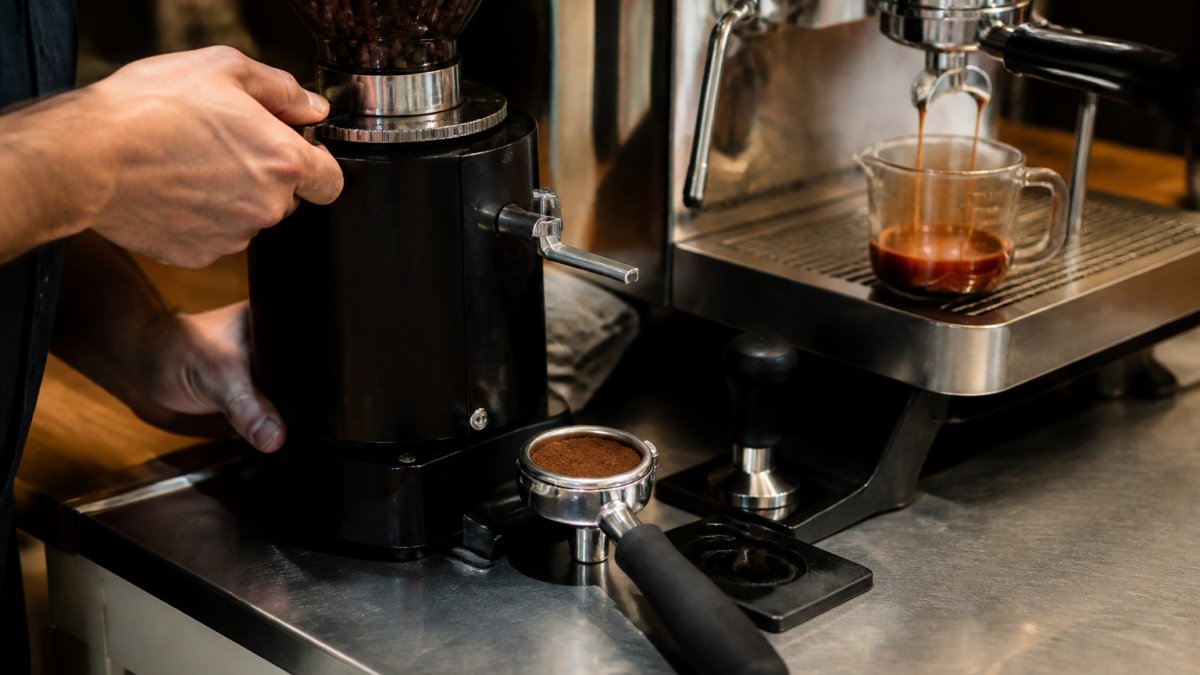
Step 1: Establish Your Baseline
Before you pull your first shot, measure and record your baseline. Weigh your dose (the amount of ground coffee you're using). A standard double shot uses 18-20 grams, but your machine's basket might call for something different. Check your portafilter.
Write down three numbers: your dose in grams, your target yield (usually 36-40 grams for a double), and your target time (25-30 seconds). These become your reference points. Every adjustment you make will either move you closer to or further from these targets.
Dose matters because it affects how water flows through the puck. A lighter dose flows faster. A heavier dose flows slower. If you change your dose, you'll need to re-dial your grind. Keep your dose consistent while you're learning.
Step 2: Pull Your First Shot and Observe Flow
Pull a shot and watch what happens in the first 5 seconds. This is the pre-infusion phase, water is saturating the coffee bed. You should see a slow, even flow start, not a gush.
If water sprays or gushes immediately, your grind is too coarse. If nothing comes out for several seconds, your grind is too fine. After pre-infusion, the flow should settle into a steady stream about the thickness of a pencil lead.
Stop the shot at your target time (usually 25-30 seconds) and weigh the output. Measure how long the entire shot took from first drop to last. Write it down. This is your baseline.
Step 3: Adjust and Test
Make one adjustment at a time. If your shot ran too fast (under 20 seconds), grind finer by one notch. If it ran too slow (over 35 seconds), grind coarser by one notch. Pull another shot and compare.
Most grinders require 3-5 shots to reach equilibrium after a grind adjustment. The first shot after a change often behaves differently than the second or third. Pull at least two shots at each setting before deciding to adjust again.
Track your adjustments. Note the grinder setting, shot time, yield, and how it tasted. Over time, you'll see patterns. You'll learn which direction your grinder favors and how sensitive it is to small changes.
When Your Espresso Grind Is Too Fine: Symptoms and Solutions
When your grind is too fine, water moves through the coffee bed slowly. The result is over-extraction, the shot pulls too long, tastes bitter, and feels heavy on your palate.
Symptoms of a grind that is too fine:
- Shot time exceeds 35 seconds
- Espresso tastes bitter, burnt, or ashy
- The crema looks dark brown or black
- Flow is slow or dripping, not streaming
- The puck feels extremely dense when you knock it out
What to do: Grind coarser by one notch. Tamp with the same pressure as before, don't change multiple variables at once. Pull another shot. If it's still running long, grind coarser again.
A common mistake is over-tamping when the grind is too fine. You think more pressure will help, but it makes the problem worse. Tamping should be firm and level, around 30 pounds of pressure. Once you've dialed in your grind, keep your tamp pressure consistent.
Bean freshness affects how fine you can grind. Fresh beans (1-3 weeks from roast) are easier to extract and may need a slightly coarser grind than older beans. At Cafe de Mattier, our slow-roast approach develops complexity that reveals itself at the right grind size. Beans that are too old won't show their character no matter how you dial in.
Espresso Extraction Time and Shot Timing
Shot timing is your primary tool for dialing in. The 25-30 second window isn't arbitrary, it's the range where most espresso machines and baskets produce balanced extraction.
Extraction time starts when water first touches the coffee bed and ends when the last drop falls from the portafilter. Use a timer or a scale that displays time. Consistency matters more than hitting an exact number.
If your shot runs 25 seconds and tastes balanced, that's your sweet spot. If it runs 28 seconds and tastes sour, you need a finer grind. If it runs 22 seconds and tastes bitter, you need a coarser grind.
Some machines have pre-infusion phases where water saturates the puck before full pressure builds. During pre-infusion, flow is slow. Once pressure builds, flow speeds up. The total time from first drop to last is what you're measuring, not just the high-pressure phase.
Yield, the weight of liquid espresso that comes out, is a secondary measure. A standard double shot yields 36-40 grams.
How Dose, Yield, Basket Size, and Grind Interact
These four variables form a system. Change one, and the others shift. Understanding how they work together prevents you from chasing your tail.
Dose is the weight of dry ground coffee you put in the portafilter. Increasing dose slows down flow because there's more coffee for water to move through. Decreasing dose speeds up flow.
Yield is the weight of liquid espresso that comes out. Yield is determined by how long you let the shot run. Stop it at 25 seconds, you get less yield.
Basket size is the capacity of your portafilter basket. A single basket (7-9 grams) holds less coffee than a double basket (18-20 grams).
Grind size controls flow rate. Finer grind slows flow. Coarser grind speeds flow.
Here's the practical consequence: if you increase your dose without adjusting grind, your shot will run longer and taste more bitter.
When switching between basket sizes, expect to adjust your grind.
Bean Freshness, Roast Level, and Grind Adjustments
Bean freshness directly affects how you dial in. Freshly roasted beans (1-2 weeks from roast) are easier to extract. Older beans (4+ weeks from roast) require finer grinds to extract properly.
The reason is CO2. Freshly roasted beans release CO2 for days. This gas creates tiny channels in the puck that allow water to flow more easily. As beans age, they release less CO2, and the puck becomes denser. A finer grind compensates by slowing water flow.
Roast level also matters. Light roasts are denser and require finer grinds than dark roasts. A light roast espresso might need your grinder set two notches finer than a dark roast from the same machine.
At Cafe de Mattier, our slow-roast tradition develops complexity that demands precision. Our African Espresso blend, sourced from Kenya, Tanzania, and Ethiopia, reveals floral notes and subtle body when dialed in correctly.

When you switch beans, expect to re-dial. Pull a few shots at your previous setting. If the shot runs too fast, grind finer. If it runs too slow, grind coarser.
Common Mistakes to Avoid When Dialing In
The biggest mistake is changing too many variables at once. You pull a shot that tastes sour, so you grind finer, increase your dose, and tamp harder.
Change one variable. Pull a shot. Evaluate. Adjust again. This takes longer, but you learn faster.
Another common error is not giving your grinder time to stabilize. After adjusting grind, the first shot often behaves differently than the second or third.
Many people also confuse the symptom with the cause. A bitter shot feels heavy, so they assume the grind is too fine.
Tamping pressure is another variable people adjust when they should be adjusting grind. A firm, level tamp is important, but it's not a dial-in tool.
Finally, don't skip the measurement step. You can dial in by taste alone, but measurement gives you data. Weight your dose and yield. Time your shots. Write it down.
Getting the best coffee grind size for espresso right transforms how your morning tastes.
Frequently Asked Questions
What is the best coffee grind size for espresso?
Espresso requires a fine, consistent grind, typically between 0.75 and 1.5 millimeters in particle size. The exact setting depends on your grinder, basket size, dose, and bean freshness. A proper espresso grind should feel like wet sand. Start at a medium-fine setting on your grinder, pull a shot, and adjust based on flow rate and taste. If water rushes through in 20 seconds, grind finer. If it takes over 35 seconds, grind coarser. The goal is 25-30 seconds for a standard double shot.
How do I know if my espresso grind is too fine?
If your espresso grind is too fine, shots will pull slowly (over 35 seconds), taste bitter or over-extracted, and may choke your machine. The puck will feel dense when tamping, and water may pool on top before flowing. You may also see excessive crema or a thin, dark stream. To fix this, grind coarser by adjusting your grinder dial one or two notches at a time. Pull a test shot after each adjustment and observe the flow rate and taste until you reach 25-30 seconds.
How long should an espresso shot take to pull?
A standard double espresso shot should pull in 25-30 seconds from the moment water contacts the puck. This timing assumes a 18-20 gram dose into a double basket. Timing alone does not determine quality, shot flow, taste, and body matter equally. If your shot is too fast (under 25 seconds), grind finer. If it's too slow (over 35 seconds), grind coarser. Bean freshness, dose, tamping pressure, and distribution also affect timing, so adjust grind first before changing other variables.
Should I change my espresso grind size for different beans?
Yes. Freshly roasted beans, darker roasts, and different origins may require grind adjustments. Fresher beans often need a slightly coarser grind due to higher CO2 content, which increases flow rate. Darker roasts like Cafe de Mattier's Italian Roast or 6 Bean Blend are denser and may pull faster, so you may need to grind finer. Lighter roasts require a finer grind. When switching beans, pull your first shot at your previous setting, observe the flow and taste, then adjust by one or two notches on your grinder dial.