

Coffee Bean Varietals: Flavor Profiles Explained
Table of Contents
- Why Coffee Varietals Shape What's in Your Cup
- Coffee Cultivar vs. Varietal: Getting the Terms Right
- The Main Coffee Species: Arabica, Robusta, Liberica, and Excelsa
- Bourbon vs. Typica Coffee: Two Heirloom Parents, Two Different Cups
- Gesha Coffee Flavor Profile and Other Varietals Worth Knowing
- How Growing Region, Altitude, and Processing Change Flavor
- How to Taste Coffee: A Practical Cupping Routine
- Varietal vs. Roast and Brew: What Actually Drives Flavor
- Frequently Asked Questions
Last Updated: October 19, 2026
Why Coffee Varietals Shape What's in Your Cup
Two bags of beans can carry the same roast date, the same origin, and the same price tag, yet taste nothing alike. The difference often comes down to coffee varietals, the genetic identities of the plants that produced the fruit. Understanding coffee bean varietals and their flavor profiles is the single fastest way to predict what a bag will taste like before you brew it. At Cafe de Mattier, we source from micro-lots and family-owned estates precisely because variety names tell us what to expect in the cup. This guide separates botanical fact from marketing fiction, compares the major varietals side by side, and shows you how to taste the difference yourself.
Coffee Cultivar vs. Varietal: Getting the Terms Right
Most coffee bags use "varietal," "variety," and "cultivar" as if they were synonyms. They are not, and the confusion makes it hard to compare one bag to another. A short taxonomy fixes the problem.
Species is the broadest category. In coffee, the commercially important species are Coffea arabica and Coffea canephora (Robusta), with Coffea liberica and Coffea excelsa as smaller players. Species is the level at which caffeine content, chromosome count, and basic disease resistance are set.
Variety is a naturally occurring subgroup within a species. In botany, the formal term is varietas, abbreviated "var." A wild Arabica population that has adapted to a specific valley over generations is a variety in this strict sense. True botanical varieties are relatively rare in commerce because most coffee plants are cultivated, not wild.
Cultivar is short for "cultivated variety." It is a plant line that humans have selected, propagated, and named for desirable traits. Typica, Bourbon, Caturra, Catuai, Pacamara, SL28, and Gesha are all cultivars.
Hybrid is a cross between two genetically distinct parents. Hybrids can be intraspecific (two Arabica cultivars, such as Pacamara, a cross of Pacas and Maragogipe) or interspecific (Arabica crossed with Robusta, such as the Timor hybrid that underpins many modern disease-resistant cultivars).
Landrace is a related term worth knowing. It refers to a locally adapted population that farmers have saved and replanted over generations without formal breeding. Many Ethiopian heirloom coffees are sold as landraces rather than named cultivars because the plants are genetically diverse and not uniformly identified.
Here is the hierarchy in plain terms:
- Species: Coffea arabica (Arabica), Coffea canephora (Robusta)
- Variety (botanical): a natural subgroup within a species, e.g., Coffea arabica var. typica in older taxonomy
- Cultivar: a human-selected, named line, e.g., Bourbon, Caturra, Gesha
- Hybrid: a cross of two distinct lines, e.g., Pacamara, Timor hybrid
- Landrace: a farmer-maintained, locally adapted population, e.g., many Ethiopian heirlooms
Why does this matter at the bag level? Because the label tells you how much genetic predictability to expect. A named cultivar like Bourbon or Gesha has a documented parentage and a reasonably consistent trait set, so a flavor description is a fair bet.
A common mistake is treating "varietal" as a botanical rank. In wine, "varietal" means a wine made from a single grape variety; coffee borrowed the word loosely. In coffee writing, "varietal" is best used as an adjective for the flavor character associated with a cultivar ("Bourbon-like sweetness") rather than as a formal taxonomic category.
The Main Coffee Species: Arabica, Robusta, Liberica, and Excelsa
Arabica and Robusta dominate global production, but Liberica and Excelsa round out the picture. Each species carries distinct genetic traits that shape yield, disease resistance, and flavor.
Arabica is prized for acidity, aroma, and complexity. It grows at higher altitudes and is more susceptible to disease, which is why it costs more to produce.
Robusta offers pest resistance, higher yield, and a heavier body with more bitterness and caffeine. It is common in espresso blends and instant coffee.
Liberica produces large, irregular beans with a smoky, woody profile. Excelsa, sometimes classified as a Liberica variety, brings tart, fruity notes.
| Species | Flavor Tendency | Caffeine | Disease Resistance |
|---|---|---|---|
| Arabica | Sweet, acidic, aromatic | Lower | Low |
| Robusta | Bitter, heavy body, nutty | Higher | High |
| Liberica | Smoky, woody, bold | Moderate | Moderate |
| Excelsa | Tart, fruity, complex | Moderate | Moderate |
Bourbon vs. Typica Coffee: Two Heirloom Parents, Two Different Cups
Bourbon and Typica are the two heirloom parents from which many modern cultivars descend. Bourbon tends toward sweetness, round body, and balanced acidity. Typica is cleaner and more delicate, with softer sweetness and a lighter body.
Most contemporary hybrids trace back to these two lines. When a roaster lists "Bourbon" on a bag, you can generally expect a sweeter, fuller cup than a Typica. Neither is objectively better; the choice depends on whether you want body or clarity. Our Guatemala lot, for example, blends Bourbon with Catuai, Caturra, and Typica for a cup that balances dark chocolate and bright fruit.

Gesha Coffee Flavor Profile and Other Varietals Worth Knowing
The Gesha coffee flavor profile is the most talked-about in specialty coffee: jasmine, bergamot, and stone fruit, with a tea-like body. It commands high prices because it is low-yielding and finicky to grow.
Other varietals worth knowing:
- SL28 and SL34: Kenyan selections prized for blackcurrant and bright acidity
- Caturra and Catuai: compact, high-yield plants common across Latin America
- Castillo: a Colombian cultivar bred for disease resistance
- Pacamara: a large-bean hybrid with chocolate and fruit notes
How Growing Region, Altitude, and Processing Change Flavor
Terroir, altitude, soil, climate, and water all interact with genetics to shape the final cup. Higher altitude slows cherry maturation, concentrating sugars and acidity. Volcanic soil, common across Central America, contributes to the mineral complexity many tasters describe.

Processing method is equally decisive. A washed process highlights clarity and acidity; a natural process pushes fruit and body forward. Our Ethiopia Natural, grown at 1,700-1,900 meters in the Sidama Zone on nitisols soil, is fully natural and dried on raised beds, which is why milk chocolate and fruit lead the profile rather than the delicate florals you might expect from the same plant washed.

How to Taste Coffee: A Practical Cupping Routine
Learning how to taste coffee is a skill built through repetition, not talent. A simple home cupping routine takes about fifteen minutes and costs nothing beyond the coffee you already own.
Here is the routine we recommend:
- Weigh 8.5 grams of medium-ground coffee into each cup
- Heat water to just off boil, around 200°F
- Pour over the grounds and let the crust form for four minutes
- Break the crust with a spoon and skim the surface
- Slurp from the spoon to aerate the liquid across your palate
- Score acidity, body, sweetness, and aroma on a simple 1-5 scale
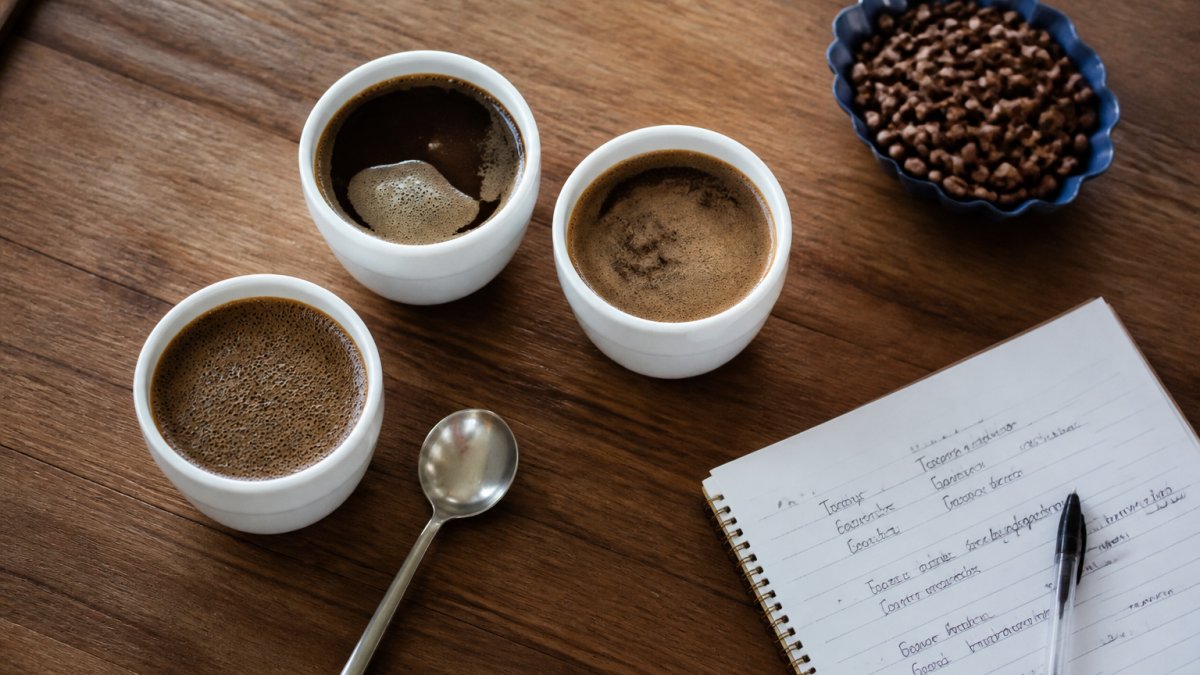
Cupping two varietals side by side is the fastest way to train your palate. The Specialty Coffee Association cupping protocols provide a standardized scoring framework if you want to go deeper.
Varietal vs. Roast and Brew: What Actually Drives Flavor
A varietal name is a probability, not a promise. The same Gesha plant can taste like jasmine and bergamot in one lot and like generic sweet coffee in another, because genetics only set a range. Four post-harvest and preparation variables decide where in that range a bag lands: processing, roast, grind, and brew. Separating them is the difference between learning from a cup and guessing at it.
Processing is the first filter. Washed coffees ferment with the fruit removed, which keeps the cup clean and lets acidity and varietal florals read clearly. Natural coffees dry with the fruit still on the seed, which adds fermented fruit, body, and sweetness that can mask delicate top notes. Honey and anaerobic processes sit in between and can push either direction.
Roast is the second filter. A light roast, dropped shortly after first crack, preserves origin character, acidity, and the aromatic compounds that carry floral and fruit notes. A dark roast, taken well into second crack, drives caramelization and Maillard reactions that produce chocolate, caramel, and smoke while volatile florals burn off.
Grind and brew are the third filter. A pour-over with a medium grind and a 1:16 coffee-to-water ratio emphasizes clarity and acidity. An espresso at a 1:2 ratio in 25 to 30 seconds concentrates body and sweetness while compressing acidity. Immersion methods like French press push body forward and soften acidity.
Water is the fourth filter, and the one home brewers most often overlook. Water with very low mineral content can make coffee taste flat and hollow; water with high alkalinity can mute acidity. The Specialty Coffee Association publishes a water standard that most specialty roasters target, and matching it is one of the cheapest upgrades a home brewer can make.
A repeatable way to separate varietal from process: cup the same cultivar from the same farm in two processing methods, then cup the same processed lot at two roast levels. If the floral note survives both washed and natural processing and both light and medium roast, it is plausibly genetic. If it disappears when processing changes, it was likely a process artifact.
The practical takeaway is to match your brewing to the varietal and to the processing. A delicate washed Gesha deserves a gentle pour-over and a light roast. A natural Robusta-forward blend holds up to milk, sugar, and a darker roast without losing its structure. Neither choice is wrong; the mistake is expecting a varietal name to override the other three variables.
Frequently Asked Questions
What is the difference between a coffee variety, varietal, and cultivar?
A variety is a naturally occurring botanical subdivision, while a varietal is the term used for the coffee plant or the single-origin coffee it produces. A cultivar is a plant selected and cultivated by humans for specific traits like yield or disease resistance. Typica and Bourbon are heirloom varietals, while Castillo and Ruiru 11 are cultivars bred for resilience. Knowing the difference helps you read a bag label accurately.
How do coffee varietals affect flavor?
Genetics set a range of possible flavors, then region, altitude, processing, and roast narrow it. Bourbon tends to bring sweetness and round body, Typica leans clean and delicate, and Gesha is known for floral and citrus notes. Two coffees of the same varietal can still taste different if grown at different altitudes or processed differently, so treat varietal as one input, not the whole answer.
Do coffee-growing regions affect flavor more than varietal?
In practice, origin and processing often shape flavor more than varietal alone. A washed Kenyan SL28 and a natural Ethiopian heirloom can both be bright and fruity, but the Kenyan shows citrus and the Ethiopian shows berry and chocolate. Varietal sets the ceiling; terroir, altitude, soil, and processing decide how much of that potential reaches the cup.
What does Gesha coffee taste like?
Gesha, also spelled Geisha, is known for jasmine and other floral notes, bergamot, stone fruit, and a tea-like body with bright acidity. It became famous after a Panamanian farm won competitions in the mid-2000s. The flavor is delicate, so light roasts and gentle brewing methods preserve it best. Expect higher prices because yields are low and demand is high.
How do Bourbon and Typica coffee differ in flavor?
Typica is the older heirloom parent, with a clean cup, mild sweetness, and modest acidity. Bourbon, a natural mutation of Typica, usually brings more sweetness, a rounder body, and notes of caramel or red fruit. Both are low-yield plants, which is why they are often replaced by hybrids. In the cup, Bourbon tends to feel fuller and sweeter than Typica.
What is the difference between a coffee varietal and a coffee blend?
A varietal refers to a single coffee plant type, usually sold as single-origin coffee from one region. A blend combines beans from multiple origins or varietals to create a consistent, balanced flavor profile. Blends are common in espresso and everyday drinking; single-origin varietals are chosen when you want to taste a specific place and plant. Neither is better, they serve different goals.