

Dark Roast vs French Roast: Acidity Comparison Guide
Table of Contents
- Dark Roast vs French Roast Acidity: The Quick Comparison
- How Roasting Duration Changes Acidity and pH Levels
- Coffee Roast Acidity Chart: From Light to French Roast
- N-Methylpyridinium (NMP): The Compound That Blocks Stomach Acid
- Acidity vs. Sourness: Why They Are Not the Same
- Low Acid Coffee Beans: What to Look For and Which Roasts Qualify
- How to Reduce Coffee Acidity: Brewing Variables and Water Chemistry
- Which Roast Is Right for Your Brewing Method and Stomach?
- Frequently Asked Questions
Last Updated: September 21, 2026
Dark Roast vs French Roast Acidity: The Quick Comparison
The dark roast vs french roast acidity comparison comes down to one measurable fact: French roast sits at the far end of the roast spectrum, so it carries less chlorogenic acid and delivers a gentler cup for sensitive stomachs. Dark roast stops earlier, keeping more bittersweet chocolate and toasted sugar notes intact. At Cafe de Mattier, we slow-roast both in small batches.

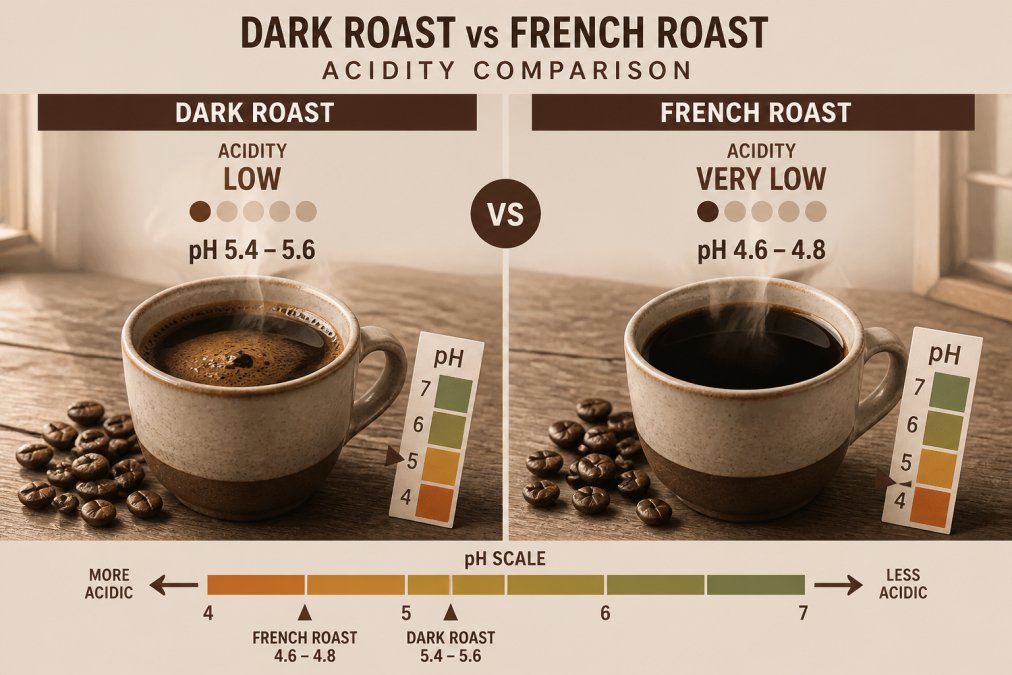
At-a-Glance Comparison Table
| Factor | Dark Roast | French Roast |
|---|---|---|
| Roast degree | Medium-dark | Darkest end of spectrum |
| Acidity level | Moderate-low | Lowest |
| Flavor profile | Bittersweet chocolate, toasted sugar | Smoky finish, bold, full-bodied |
| Caffeine content | Slightly lower | Slightly lower |
| Best for | Balanced daily cups | Stomach sensitivity, espresso |
| Cafe de Mattier option | French Roast ($23.99) | Italian Roast ($23.99) |
How Roasting Duration Changes Acidity and pH Levels
Roasting duration is the single biggest lever on coffee acidity. Green coffee starts acidic, and heat steadily breaks down the acids responsible for that sharpness. The longer the roast runs, the more acidity gets mellowed.

The Maillard Reaction and Chlorogenic Acid Breakdown
The Maillard reaction is the browning process that creates coffee's aroma and color as sugars and amino acids react under heat. Chlorogenic acid, one of the main acids in green coffee, degrades steadily through it.
Coffee Roast Acidity Chart: From Light to French Roast
A coffee roast acidity chart traces acidity falling as roast degree rises: light roasts at the top, French roast at the bottom.
- Light roast: Highest acidity, bright and fruity, floral notes intact
- Medium roast: Balanced acidity, caramel sweetness, rounded body
- Medium-dark (dark roast): Lower acidity, bittersweet chocolate, toasted sugar
- Dark roast: Low acidity, smoky finish, full-bodied
- French roast: Lowest acidity, bold, oily surface, intense roast character
N-Methylpyridinium (NMP): The Compound That Blocks Stomach Acid
N-methylpyridinium, or NMP, is why a French roast can sit easier on a sensitive stomach than a light roast with identical caffeine. It is roast-derived, not bean-origin, the piece most guides skip.
How NMP Forms During Roasting
NMP is not present in green coffee. It forms when trigonelline, a naturally occurring alkaloid in green beans, degrades under sustained heat. The longer and darker the roast, the more trigonelline converts and the higher the NMP concentration.
What NMP Actually Does in the Stomach
Gastric acid production is driven in part by parietal cells in the stomach lining, which respond to histamine and other signals by pumping acid. Research points to NMP as a compound that interferes with that signaling pathway, reducing the acid those cells produce. In plain terms: NMP appears to tell the stomach to pump less acid when coffee arrives.
- Less chlorogenic acid, fewer of the compounds that read as sharp and acidic on the palate and in the gut.
- More NMP, a roast-derived compound that appears to dampen the stomach's acid response.
Why This Matters More Than Caffeine for Sensitive Stomachs
Most people assume caffeine is the culprit when coffee upsets their stomach. Caffeine does stimulate gastric acid, but roast degree often has a larger effect on tolerance. A dark roast with more NMP and less chlorogenic acid can sit better than a light roast with the same caffeine, because the irritants have been reduced while the compound that blunts the response has increased.
Where NMP Fits on the Roast Spectrum
NMP accumulates as roast duration increases, so the ranking follows the roast chart:
- Light roast: Lowest NMP, highest retained trigonelline, highest chlorogenic acid.
- Medium roast: Moderate NMP, moderate chlorogenic acid, balanced cup.
- Dark roast: Higher NMP, lower chlorogenic acid, noticeably gentler on the stomach.
- French roast: Highest NMP among common roast levels, lowest chlorogenic acid, the most stomach-friendly profile in the standard spectrum.
- Italian roast: Roasted even darker than French in most roasteries, with NMP near its practical ceiling and chlorogenic acid largely degraded.
Acidity vs. Sourness: Why They Are Not the Same
Acidity and sourness are not interchangeable, and conflating them leads people to the wrong beans. Acidity is a measurable chemical property reflected in pH; sourness is a taste perception that can come from under-extraction rather than the bean itself.
Low Acid Coffee Beans: What to Look For and Which Roasts Qualify
Low acid coffee beans come from the darker end of the roast spectrum. French and Italian roast qualify most clearly, followed by other dark roasts.
How to Reduce Coffee Acidity: Brewing Variables and Water Chemistry
Roast degree is the biggest lever on coffee acidity, but not the only one. Two cups brewed from the same French roast can taste dramatically different depending on extraction and water, the part most roast-comparison guides skip, and where the real control lives.
Extraction: Why the Same Bean Tastes Sharper or Softer
Coffee acidity is determined by how much of the bean's soluble material ends up in your cup. Under-extraction pulls the bright, sharp acids first and leaves the sweeter, heavier compounds behind, producing a sour, thin cup. Over-extraction pulls bitter compounds that mask acidity but introduce a harsh, drying finish. The target is the middle: enough extraction to round off sharp edges without dragging in bitterness.
Four variables control that balance:
- Grind size. Finer grinds expose more surface area and extract faster. For dark roasts, which are more porous and soluble, a coarser grind prevents over-extraction and the harshness that comes with it. For light roasts, a finer grind is usually needed to reach full extraction.
- Water temperature. Water just off the boil extracts fewer of the bright acids than a rolling boil. Lowering brew temperature by a few degrees is one of the simplest ways to soften perceived acidity without changing beans.
- Brew time and ratio. Longer contact time pulls more acid into the cup. Shortening the brew or increasing the coffee-to-water ratio shifts the balance toward sweetness and body.
- Brewing method. This is the variable most guides ignore. Cold brew extracts at low temperature over many hours, which suppresses the acids that read as sharp and produces a rounder, lower-acidity cup, even from a medium roast. Espresso, by contrast, forces hot water through fine grounds under pressure in seconds, concentrating both acids and body. A French roast pulled as espresso can taste more intense and more acidic than the same bean brewed as cold brew.
Water Chemistry: The Overlooked Buffer
Water is roughly 98 percent of your cup, and its mineral content changes how acidity is perceived. Two factors dominate:
- Alkalinity (bicarbonate buffer). Water with higher bicarbonate content neutralizes some of coffee's acids before they reach your tongue. This is why the same beans can taste flatter in one city and brighter in another. Very high alkalinity, though, can mute flavor entirely and produce a chalky, dull cup.
- pH. Water that is itself slightly alkaline buffers coffee acidity; water that is slightly acidic amplifies it. Most tap water sits near neutral, but soft water and some filtered waters lean acidic and can make even a French roast taste brighter than expected.
A Practical Order of Operations
For a lower-acid cup, work through the variables in this order:
- Choose the roast. French roast or Italian roast sets the lowest-acid baseline.
- Match the grind to the roast. Coarser for dark roasts to avoid over-extraction.
- Lower the brew temperature slightly. A few degrees below boiling reduces extracted acids.
- Consider cold brew. Low-temperature, long-steep extraction suppresses sharp acids regardless of roast.
- Adjust your water. Moderate-mineral water buffers acidity without flattening flavor.
Which Roast Is Right for Your Brewing Method and Stomach?
Match the roast to both your brewing method and your stomach. There is no single best answer, only the best fit for your setup.
| Your Priority | Best Roast | Why |
|---|---|---|
| Espresso and milk drinks | French or dark roast | Bold, full-bodied, holds up |
| Balanced daily cup | Dark roast | Bittersweet, moderate acidity |
| Stomach sensitivity | French or Italian roast | Higher NMP, lower acid |
| Bright, fruity flavor | Light roast | Higher acidity, floral notes |
Frequently Asked Questions
Which coffee roast is the least acidic?
French roast and Italian roast are the least acidic because longer roasting breaks down chlorogenic acid and triggers higher N-methylpyridinium (NMP) production. NMP tells your stomach to reduce acid secretion. For the lowest acidity, choose a dark roast or French roast from low acid coffee beans, and consider cold brew to further reduce perceived acidity.
Is French roast better than dark roast for acid reflux?
French roast is generally better for acid reflux because it is roasted longer and darker than a standard dark roast, resulting in lower chlorogenic acid and higher NMP. However, individual tolerance varies. If you are sensitive, try a French roast brewed with a paper filter or as cold brew to minimize acidity further.
How does the coffee roast acidity chart help me choose?
A coffee roast acidity chart shows pH levels and acid content across roast degrees. Use the chart to match your stomach sensitivity and flavor preference: lower pH means brighter, more acidic taste; higher pH means mellower, bittersweet notes.
Can I reduce coffee acidity without switching to dark roast?
Yes. How to reduce coffee acidity includes: use a paper filter to trap oils and acids, brew with cold water (cold brew), choose a coarser grind, lower water temperature (around 195°F), and add a pinch of salt or milk. Also, try low acid coffee beans like French roast or Italian roast from Cafe de Mattier, which are slow-roasted to reduce acidity.
Does French roast have more caffeine than dark roast?
Caffeine content is similar between dark and French roast because caffeine is stable during roasting. However, French roast may have slightly less caffeine by volume if beans lose more mass, but by weight, the difference is negligible. Focus on acidity, not caffeine, when choosing between these roasts.