

How to Brew High-End Single-Origin Coffee at Home
Table of Contents
- What Makes Single-Origin Coffee Worth Brewing Carefully
- The Best Brewing Methods for Single Origin Coffee
- Coffee Grind Size Guide for Pour Over and Other Methods
- The Ideal Water Temperature for Specialty Coffee
- Step-by-Step: Brewing High-End Single-Origin Coffee
- Water Chemistry, Bean Processing, and Advanced Sensory Evaluation
- Equipment Maintenance for Flavor Clarity
- Where to Start With High-End Beans
- Frequently Asked Questions
Last Updated: September 27, 2026
What Makes Single-Origin Coffee Worth Brewing Carefully
Single-origin coffee comes from one specific farm, region, or producer rather than a blend. That traceability means every bag carries a distinct flavor profile shaped by its altitude, soil, and processing method.
This guide from Cafe de Mattier breaks down how to brew high-end single-origin coffee, from grind size to water chemistry, including mineral content, extraction yield, and how a washed Ethiopian differs from a natural one on the same recipe.

The Best Brewing Methods for Single Origin Coffee
The best brewing methods for single origin coffee are pour-over and French press, because each isolates the bean's character differently. Pour-over produces clarity and flavor separation; French press delivers body and mouthfeel. Neither is "better", they answer different questions.
Pour-Over: Maximum Clarity and Flavor Separation
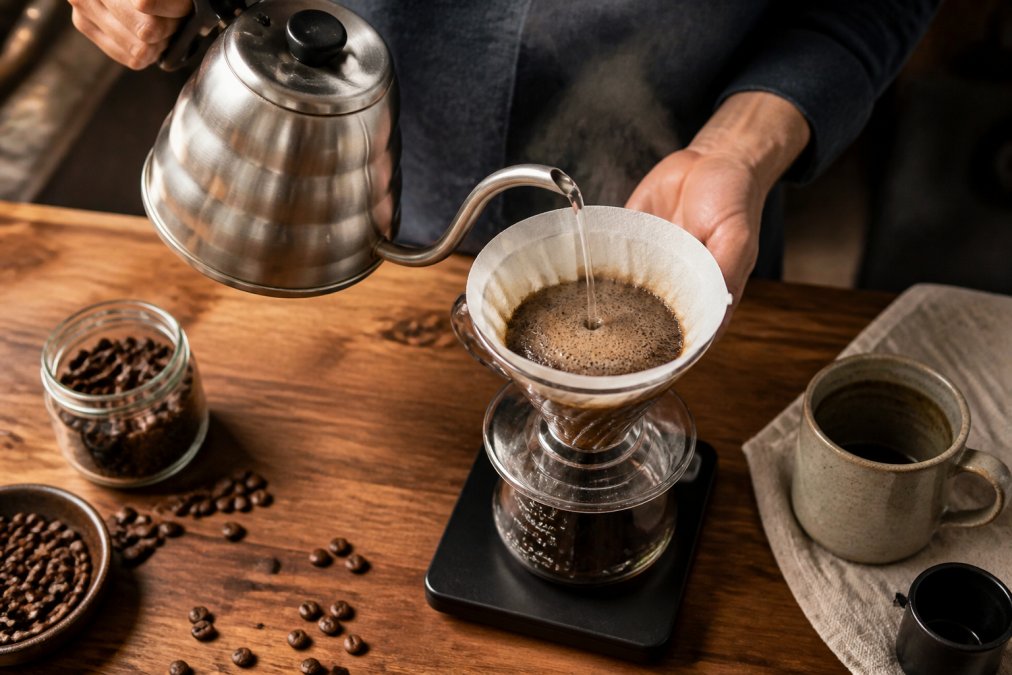
Pour-over forces water through a bed of coffee at a controlled rate, highlighting acidity, floral notes, and origin-specific tasting notes. It's the method most specialty roasters reach for when evaluating a new micro-lot, but it punishes inconsistency in grind and pour speed more than any other method. A gooseneck kettle and scale aren't optional, they're the difference between a clean cup and a muddy one.
French Press: Full Body and Rich Mouthfeel
Immersion brewing keeps grounds in full contact with water, extracting more oils and suspended solids for a heavier body and rounder mouthfeel, often at the cost of some top-end clarity. If your single-origin coffee leans toward chocolate, caramel, or dried fruit, French press flatters it; if it's a bright Kenyan with lemon and floral notes, pour-over usually wins.
Coffee Grind Size Guide for Pour Over and Other Methods
Grind size is the single largest lever you control: it determines how fast water moves through the coffee bed and how much gets extracted.
| Method | Grind Size | Brew Time | Texture |
|---|---|---|---|
| Pour-over | Medium-fine | 2:30-3:30 | Fine as table salt |
| French press | Coarse | 4:00-5:00 | Rough as sea salt |
| Espresso | Fine | 25-30 sec | Powdered sugar |
| AeroPress | Medium-fine | 1:30-2:30 | Fine as table salt |
| Moka pot | Fine-medium | 4:00-5:00 | Between table salt and powdered sugar |
| Cold brew | Extra coarse | 12-18 hrs | Rough as peppercorns |
Why Particle Distribution Beats Average Grind Size
Two grinders set to the same "medium-fine" setting can produce wildly different cups because they produce different particle distributions. A burr grinder crushes beans between two rotating surfaces, yielding a narrow range of particle sizes; a blade grinder chops with spinning metal, yielding dust that over-extracts into bitterness alongside boulders that under-extract into sourness. No technique fixes a blade grinder's distribution, uniform particles extract at the same rate, so the cup tastes like one thing instead of several fighting each other.
How Processing Method Shifts Your Grind
Washed processed beans, fruit removed before drying, are denser and cleaner, extract more slowly, and reward a slightly finer grind or higher water temperature. A washed Ethiopian or Kenyan tastes flat and tea-like if brewed with a natural's recipe.
Grind Freshness
Ground coffee stales in minutes, not days, the surface area that enables extraction also exposes aromatics to oxygen. If you can't grind right before brewing, grind within the hour and store grounds airtight, away from light and heat. For a $24 single-origin, fresh-ground versus pre-ground matters more than a $150 versus $400 grinder.
The Ideal Water Temperature for Specialty Coffee
The ideal water temperature for specialty coffee is 195-205°F (91-96°C). Below that range, you under-extract and get a sour, thin cup. Above it, you scorch the grounds and pull out bitterness.
Single Origin Favorites Sample Pack →
Step-by-Step: Brewing High-End Single-Origin Coffee
Here's the full process for a pour-over, the method that best showcases a single-origin coffee's complexity. Total time: about 5 minutes.
- Weigh your dose. Use a 1:16 ratio: 15g coffee to 240g water. For a brighter, tea-like cup, shift to 1:17; for a heavier, sweeter cup, shift to 1:15.
- Heat your water to 200°F for a medium roast, 205°F for a light roast. Let the kettle sit 30 seconds off boil if you're brewing a dark roast.
- Rinse the filter with hot water to remove paper taste, then discard. This also preheats the dripper so the first pour doesn't lose heat to cold ceramic.
- Grind medium-fine and add the grounds to the rinsed filter. Level the bed by tapping the dripper, an uneven bed channels no matter how good your pour is.
- Bloom the coffee with 45g of water, then wait 30-45 seconds. Pour the bloom water in a tight spiral, making sure every ground is saturated.
- Pour in slow circles, working outward from the center, in two or three stages. Keep the water level roughly 1 inch above the bed and pour at about 5-7 grams per second, the reason gooseneck kettles exist.
- Finish the brew between 2:30 and 3:30 total. Taste and adjust grind next time.
Reading the Brew: What the Numbers Tell You
A finished pour-over gives you three diagnostic signals before you taste it: total brew time, drawdown time, and the shape of the coffee bed after draining.
- Brew ran under 2:30 and the bed looks flat and dry: the grind is too coarse or the pour was too fast. Water passed through before it could dissolve sugars, so the cup will taste sour, thin, and hollow.
- Brew ran past 3:30 and the bed looks muddy with water pooled on top: the grind is too fine or you agitated too much. The cup will taste bitter, drying, and chalky.
- Brew hit 2:30-3:30 and the bed is level with a slight dome: you're in range. Now adjust for taste, not time.
Adjusting the Next Brew
The Bloom Phase and Why It Matters
The bloom phase is the first pour of hot water onto fresh grounds, releasing trapped carbon dioxide and preparing the bed for even extraction. Skip it and escaping gas pushes water away from the grounds, causing uneven extraction.
Water Chemistry, Bean Processing, and Advanced Sensory Evaluation
Water chemistry and processing method change flavor before you touch a kettle. Two beans from the same farm, processed differently, brew into entirely different cups.
Equipment Maintenance for Flavor Clarity
Equipment maintenance is the most neglected variable in home brewing, and it silently degrades every cup: oils build up on grinder burrs, rancidity develops in dirty brewers, and scale accumulates in kettles. Clean your burr grinder every few weeks with grinder-cleaning tablets or uncooked rice, old oils go stale and taint every batch with a flat, cardboard-like note, the most common reason a bean that tasted great in the shop tastes dull at home.
Where to Start With High-End Beans
Start with a sample pack before committing to a full bag. Cafe de Mattier's Single Origin Favorites Sample Pack ($24.99) includes six 2-ounce packs spanning Brazil Santos, Colombia, Costa Rica, Ethiopia, Honduras, and Tanzania. That range lets you taste how processing and altitude change the same brewing method, more instructive in a week than months of reading.
Frequently Asked Questions
What is the 15-15-15 rule for coffee?
The 15-15-15 rule refers to a simple brewing ratio: 15 grams of coffee to 15 ounces of water, brewed for 15 minutes in a cold brew or immersion setup. For hot pour-over methods, a more common starting point is a 1:15 to 1:17 dose-to-yield ratio. Adjust based on the specific single-origin coffee and your preferred strength. A coffee scale helps you measure consistently and repeat results.
How do water temperature and grind size affect single-origin flavor profiles?
Water temperature and grind size directly control extraction yield. Water between 195°F and 205°F is the sweet spot for specialty coffee. Cooler water under-extracts, leaving a sour or thin cup. Hotter water over-extracts, bringing bitterness and a dry aftertaste. Finer grinds extract faster; coarser grinds slow extraction. For pour-over, a medium-fine grind with water at 200°F typically highlights floral and fruity notes in beans like Ethiopia Natural.
What is the difference between micro-lot and standard single-origin coffee?
Single-origin coffee comes from one country or region. Micro-lot coffee goes further: it is a small, separately harvested and processed batch from a specific farm, cooperative, or even a single hillside within a region. Micro-lots offer traceable flavor profiles tied to altitude, soil, and processing method. For example, the Ethiopia Natural in Cafe de Mattier's Single Origin Favorites Sample Pack is a full natural process from the Sidama Zone at 1700-1900 meters, giving it distinct fruity and caramel notes.
How can I highlight floral notes and silk-like body in my home brew?
Start with beans that carry those characteristics, like the Kenya single origin with its bright acidity, orange, lemon, and floral tasting notes. Use a medium-fine grind and water at 200°F. Pour slowly in circular motions to keep the coffee bed even and avoid channeling. A gooseneck kettle gives you control over flow rate. Aim for a total brew time of 2:30 to 3:00 minutes. Serve in a preheated ceramic mug to preserve aroma and mouthfeel.