

What Is a Slow Coffee Ritual? A Mindful Brewing Guide
Table of Contents
- What a Slow Coffee Ritual Actually Is (and What It Isn't)
- Mindful Coffee Brewing Techniques You Can Start Using Tomorrow
- A Step-by-Step Morning Ritual: From Grind to First Sip
- Best Manual Coffee Brewers for Beginners
- The Benefits of Slow Coffee: What Changes When You Slow Down
- Equipment Minimalism vs. Maximalism: What You Really Need
- When the Ritual Stops Working: Troubleshooting the Mindset
- Frequently Asked Questions
Last Updated: September 18, 2026
What a Slow Coffee Ritual Actually Is (and What It Isn't)
A slow coffee ritual means brewing with full attention, treating each step as part of the experience rather than an obstacle between you and caffeine. It's about intention, not brewing slowly for its own sake.
The Difference Between Speed and Intention
Speed gets you coffee. Intention gets you a ritual.
Most people treat brewing as a task: scoop, pour, walk away. The result tastes fine, but nothing sticks.
Mindful Coffee Brewing Techniques You Can Start Using Tomorrow
Mindful coffee brewing techniques are small adjustments that pull your focus into the present moment, no new equipment or extra time, just your senses engaged on purpose.
Here are five techniques to try:
- Listen to the kettle. Wait for the water to settle after boiling. The quiet after the roar is your cue.
- Smell the grounds before brewing. Ground beans release their aroma profile immediately. Notice it.
- Watch the bloom. That first pour causes grounds to swell and release gas. It takes about 30 seconds.
- Feel the weight of the vessel. Notice the shift as your brewing vessel fills.
- Sip before you swallow. Let the first taste register before you take another.
The Bloom Phase: Your First 30 Seconds of Presence
The bloom phase is the moment hot water first meets ground coffee: grounds expand, bubbles form, carbon dioxide escapes. It's the most visually alive part of manual extraction, and most people pour through it without looking.
A Step-by-Step Morning Ritual: From Grind to First Sip
Here's a simple sequence you can follow tomorrow, about 10 minutes from start to first sip.
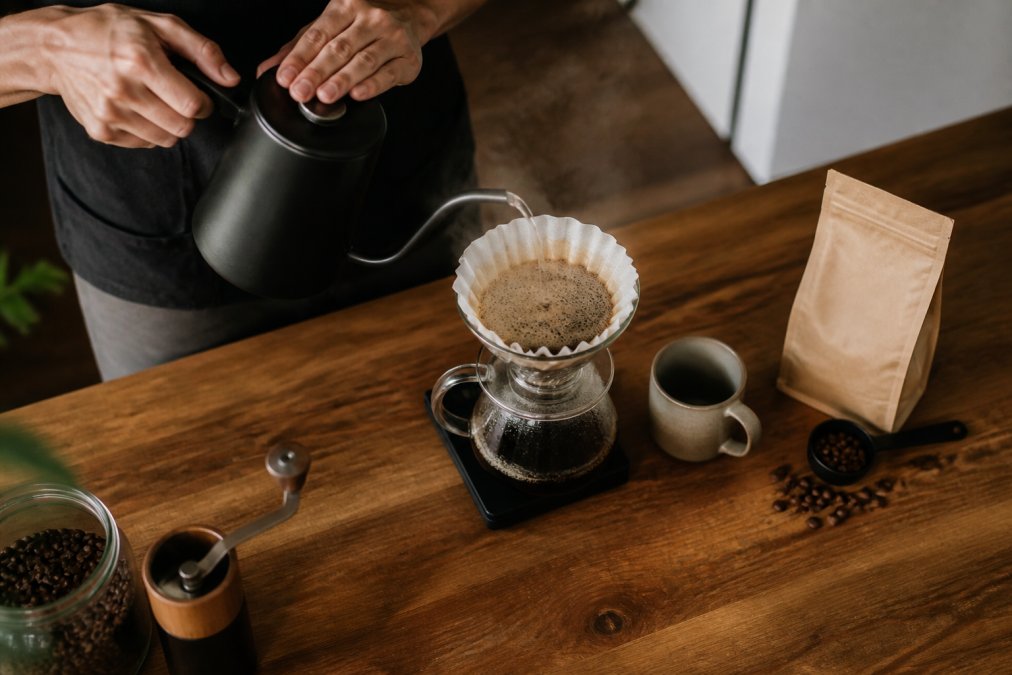
What you'll need:
- Whole bean coffee
- Burr grinder
- Gooseneck kettle
- Pour-over dripper or French press
- Filter
- Scale
- Your favorite mug
Best Manual Coffee Brewers for Beginners
The best manual coffee brewer for beginners is a pour-over dripper: forgiving, affordable, and it teaches you how brewing parameters affect flavor. A French press is next easiest.
Here's a quick comparison:
| Brewer | Brew Time | Skill Level | Best For |
|---|---|---|---|
| Pour-over dripper | 3-4 min | Beginner | Clean, bright cups |
| French press | 4-5 min | Beginner | Full-bodied, rich texture |
| AeroPress | 2-3 min | Beginner | Versatility and speed |
| Moka pot | 5-6 min | Intermediate | Strong, espresso-like coffee |
| Chemex | 4-5 min | Intermediate | Larger batches, clarity |
The Benefits of Slow Coffee: What Changes When You Slow Down
The benefits of slow coffee show up in two places: your cup and your head. Slower brewing gives you more control over extraction; paying attention gives you a repeatable pause before the day starts.
What Changes in the Cup
Extraction is a function of time, temperature, agitation, and grind. Brew fast and distracted and you lose control of three of those four; slow down and you gain them back.
- Time. A pour-over that finishes in 2:30 versus 4:00 produces measurably different cups from the same beans. Under-extracted coffee reads as sour, thin, and salty. Over-extracted coffee reads as bitter, dry, and hollow. The window between them is narrow, often under a minute.
- Temperature. Water straight off a rolling boil is roughly 212°F at sea level. Most manual brewers perform best between 195°F and 205°F. That 30-second rest after boiling is not ceremony; it is a temperature adjustment.
- Agitation. A steady circular pour keeps the coffee bed even. A rushed pour channels water through one spot, leaving the rest of the bed under-extracted. This is why the same beans taste different on a rushed Monday and a slow Saturday.
What Changes in the Body
The repetitive, low-stakes motions of grinding, pouring, and waiting demand just enough attention to crowd out rumination without creating pressure. Most practitioners describe the same sequence: shoulders drop, jaw unclenches, breathing slows.
A few honest caveats:
- This is not a substitute for treatment. If you are dealing with clinical anxiety or sleep problems, a coffee ritual is a nice habit, not a therapy.
- Caffeine is still caffeine. A slow ritual does not change the pharmacology of the cup. If you are sensitive, the pause is the benefit, not the dose.
- The effect is cumulative, not dramatic. Nobody finishes a pour-over and feels transformed. The value is in the pattern repeating across weeks.
Why the Ritual Beats the Result
If the goal were only a good cup, an automatic brewer and a scale would do it. A manual ritual feels different because it puts you inside the process: you're not waiting for coffee, you're making it. That distinction is small on paper and large in practice.
Equipment Minimalism vs. Maximalism: What You Really Need
Every guide says start simple, but almost none say what 'simple' costs, what it takes up, or how to build a ritual in a closet-sized kitchen.
The True Minimum
You can run a complete slow coffee ritual with four items. Nothing else is required.
| Item | What It Does | Typical U.S. Price Range | Footprint |
|---|---|---|---|
| Manual burr grinder | Consistent particle size | $30-$60 (entry), $100+ (upgrade) | About the size of a large mug |
| Pour-over dripper | Brews a single cup | $10-$25 | Smaller than a cereal bowl |
| Paper filters | Filtration | $5-$10 per 100 | A small box |
| Kettle | Heats water | $15-$30 (stovetop), $40-$100 (electric gooseneck) | One burner or one outlet |
Building a Ritual in a Small Space
If your counter is full, the ritual doesn't have to live on the counter. A few patterns that work:
- Store vertically. A single shelf or a small tray that holds the grinder, dripper, and filters keeps the setup contained and makes setup and teardown part of the ritual itself.
- Use the dripper directly on the mug. No carafe, no server, no extra vessel to wash. One brew, one cup, one rinse.
- Skip the gooseneck if space is the constraint. A stovetop kettle with a modest spout is harder to control but takes up less room and costs less. Your first few cups will be less even. That is fine.
- Grind at the store if you must. Pre-ground coffee loses aroma faster, but it removes the grinder from the equation entirely. If that is what gets you brewing instead of skipping it, do it.
When Maximalism Is Actually Worth It
Maximalism isn't wrong, it's just expensive in two currencies: money and attention. It's worth it when you have a specific question for the equipment to answer.
- You want to isolate grind size. A better burr grinder is the single highest-leverage upgrade in manual coffee. It changes every cup, not just some.
- You want to isolate temperature. An electric gooseneck with temperature control removes the guesswork from the 195°F-205°F window.
- You want to compare methods. A second brewer (French press, AeroPress) lets you taste the same beans two ways. This is genuinely educational, but only after you have mastered one method.
A Decision Rule
- If your goal is calm: buy the four-item minimum. Stop there for at least a month.
- If your goal is learning: add one variable at a time, and change nothing else for two weeks so you can actually taste the difference.
- If your goal is both: start minimal, and let the upgrades earn their place by answering a question you already have.
One Thing Worth Spending On
The mug matters more than most guides admit. One you enjoy holding, the weight, the rim, the way it sits in your hand, turns the last step of the ritual into something you look forward to rather than tolerate. A small upgrade with an outsized effect on whether the habit sticks.
When the Ritual Stops Working: Troubleshooting the Mindset
The ritual stops working when it becomes another task on your list. If you're timing yourself, tracking streaks, or feeling guilty about skipping a day, you've turned a practice into a performance.
Signs it's time to reset:
- You rush through brewing to get to something else
- You feel anxious when you can't brew exactly the same way
- You stop noticing the aroma, the steam, or the taste
- You've added so many steps that brewing feels like work
Frequently Asked Questions
What is a slow coffee ritual?
A slow coffee ritual is a deliberate, unhurried approach to brewing where you treat each step, from grinding beans to pouring water, as part of a calming practice rather than a task to rush through. It combines manual extraction methods like pour-over with attention to sensory details such as aroma and steam. The goal is not speed but presence, turning a five-minute routine into a grounding start to your day.
What does 'slow coffee' mean, and how is it different from regular brewing?
Slow coffee refers to both the brewing method and the mindset behind it. Instead of a drip machine that finishes in under a minute, slow coffee uses manual techniques like pour-over or French press that take three to five minutes of active involvement. The difference is intentionality: you measure, you watch the bloom phase, you notice the aroma. The result is a cup you pay attention to, not one you drink on autopilot.
What equipment do I need for a slow coffee ritual?
You need four things: a manual brewer (a pour-over cone or French press works well), a burr grinder for consistent grind, a gooseneck kettle for controlled pouring, and a scale for accurate ratios. A ceramic mug you enjoy holding matters more than you might think. Cafe de Mattier's 11 oz mug or 15 oz mug both work well here.
How does a slow coffee ritual improve mental well-being?
The benefits of slow coffee come from what psychologists call a predictable, sensory anchor. Focusing on water temperature, the bloom phase, and the aroma profile gives your mind a single point of attention before the day's demands begin. This kind of intentionality can support nervous system regulation by reducing the rush that typically starts the morning. It is not therapy, but it is a small, repeatable practice that many people find genuinely calming.