

Best Coffee Beans for Low Acidity Roast: 2026 Guide
Table of Contents
- What Makes a Coffee Bean Low in Acidity
- Origin, Altitude, and Processing: How They Shape Acidity
- Dark Roast vs Light Roast Acidity: What the Roast Level Really Does
- How to Reduce Coffee Acidity at Home
- Best Brewing Methods for Low Acid Coffee
- Best Coffee Beans for Low Acidity Roast: Top Picks
- Frequently Asked Questions
Last Updated: September 26, 2026
What Makes a Coffee Bean Low in Acidity
A low acidity roast starts with the bean itself, not just the roasting curve. The best coffee beans for low acidity roast share a few traits: they grow at lower altitudes, they're often processed in ways that mute sharp acids, and they tend to be roasted darker. At Cafe de Mattier, we source single-origin beans from micro-lots and family-owned estates, which lets us trace exactly how origin and processing shape what you taste.

Chlorogenic Acid and Perceived Acidity
Chlorogenic acid is the main compound behind coffee's bright, tangy bite. It breaks down as roasting temperature climbs, so a darker roast leaves less of it behind. That's why a dark roast often tastes smoother and sits easier than a light one, even when both come from the same green bean.
Origin, Altitude, and Processing: How They Shape Acidity
Altitude does more to shape acidity than almost any other growing factor. Beans grown high up develop denser structure and sharper acids. Beans from low altitude and mineral-heavy soil, by contrast, tend to land softer and rounder in the cup.
Specialty Coffee Association research on green coffee
Dark Roast vs Light Roast Acidity: What the Roast Level Really Does
Dark roast vs light roast acidity comes down to heat and time, but the mechanism is more specific than most guides let on. Chlorogenic acid, the lactone family largely responsible for coffee's bright, tangy bite, begins degrading measurably once bean temperature passes roughly 400°F, and continues breaking down through first crack and into second crack. A light roast pulled just after first crack retains the majority of its chlorogenic acid; a dark roast taken well into second crack retains a small fraction.
What Each Roast Level Actually Tastes Like
- Light roast (City, ~415-425°F bean temp): Highest retained chlorogenic acid, brightest perceived acidity, most origin character. Usually the worst choice for a sensitive stomach.
- Medium roast (Full City, ~430-440°F): Partial chlorogenic acid breakdown. Acidity reads as structured rather than sharp. A reasonable middle ground.
- Medium-dark roast (Vienna, into second crack): Most of the sharp acids are gone, body thickens, sugars caramelize. This is where most self-described "low acid" coffees sit.
- Dark roast (French, Italian, well into second crack): Lowest retained chlorogenic acid, heaviest body, smokier and more bittersweet. The gentlest cup on the stomach, but also the easiest to over-roast into ash.
The Trade-Off Nobody Prices In
Pushing the roast darker does reduce perceived acidity, but it also destroys the volatile compounds responsible for floral, citrus, and berry notes. Past a certain point you are not drinking origin anymore, you are drinking roast. A full city or full city+ roast is the practical sweet spot for most sensitive drinkers: enough development to soften the acid, not so much that the cup turns flat and ashy.
How to Reduce Coffee Acidity at Home
Learning how to reduce coffee acidity starts in the brew, not the bag. Three levers do most of the work:
- Grind coarser. A finer grind extracts more acid compounds. Coarse grounds pull less of them into the cup.
- Lower the water temperature. Water just off the boil extracts fewer harsh acids than a rolling boil.
- Shorten contact time. A faster brew leaves less time for acids to dissolve.
Water Chemistry and Its Effect on pH
Water chemistry is the lever almost nobody talks about. Mineral-heavy water buffers acidity and can make coffee taste flatter but gentler, while very soft or distilled water lets acids come through sharp and thin. If your tap water tastes good on its own, it will usually brew good coffee. If it tastes metallic or overly hard, filtered water will smooth the cup before you change anything else.
Best Brewing Methods for Low Acid Coffee
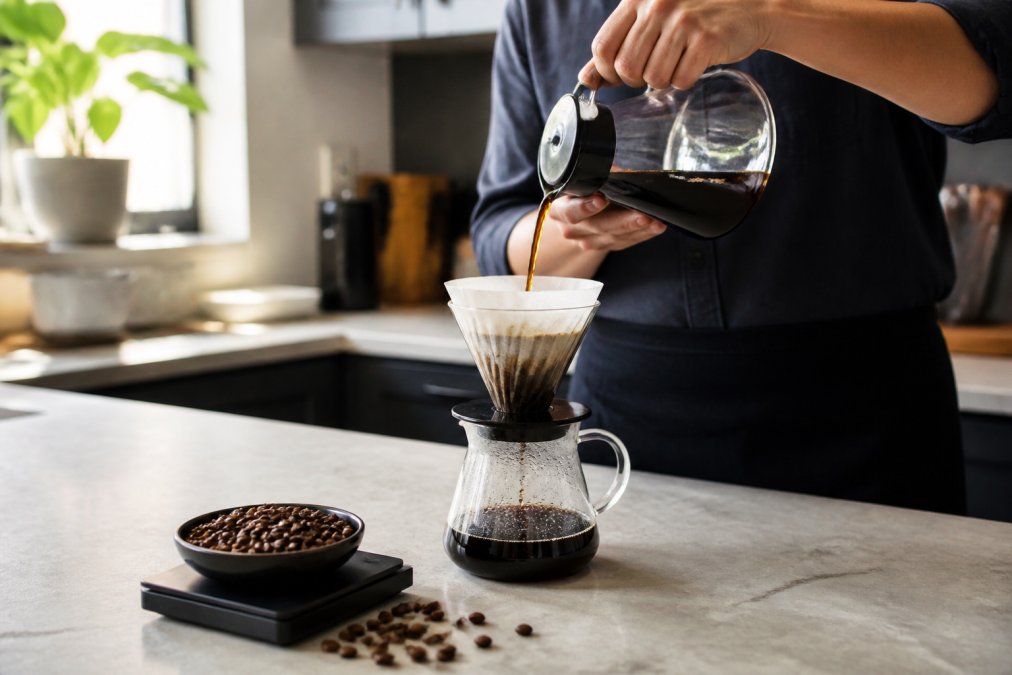
Most guides stop at "cold brew is smoother." That is true, but it is not the whole story. The acidity you actually taste in the cup is a function of three things: how much acid the water extracts from the grounds, how much of that acid your palate perceives, and what else is in the cup buffering it. Brewing method touches all three.
Why Cold Brew Works, and Where It Stops
Cold brew extracts fewer acids because the acids in coffee are more soluble in hot water than in cold. A 12-to-16-hour steep at room temperature or below pulls the sugars, body, and much of the caffeine, but leaves a larger share of the sharp chlorogenic acid lactones behind in the grounds. The result is a cup that typically reads noticeably smoother than the same beans brewed hot.
Hot Brewing: The Three Levers That Matter
For hot coffee, the same three variables do most of the work regardless of method:
- Grind size. Finer grinds expose more surface area and extract more acid. Coarser grinds pull less of it into the cup. This is why a French press with a coarse grind usually tastes rounder than a moka pot with the same beans.
- Water temperature. Water just off the boil (195-205°F) extracts fewer harsh acids than a rolling boil. Dropping to 185-195°F softens the cup further, at the cost of some sweetness.
- Contact time. A faster brew leaves less time for acids to dissolve. A 2-minute AeroPress or a short pour-over will taste brighter and sharper than a 4-minute full immersion.
Method-by-Method Comparison
- Cold brew: Lowest perceived acidity. Best for sensitive stomachs. Loses aromatic top notes.
- French press: Coarse grind plus full immersion gives a round, low-acid cup. The metal filter lets some fines through, which adds body.
- Pour-over (V60, Chemex): Paper filters trap some oils and fine particles that carry acids, so a pour-over can taste cleaner and slightly less acidic than a French press of the same beans, provided you keep the grind coarse and the water temperature moderate.
- Drip machine: Depends entirely on the machine. A machine that holds water at 200°F and finishes in 4-5 minutes will extract more acid than a French press. A machine that runs cool or fast will extract less.
- Moka pot: High pressure, fine grind, near-boiling water. One of the highest-acid methods available. Avoid if your stomach is the concern.
- Espresso: High pressure and fine grind pull maximum acid per unit of water. A single shot can carry more perceived acidity than a full mug of cold brew. Rarely the answer for sensitive drinkers.
Water Chemistry and Its Effect on pH
Water chemistry is the lever almost nobody talks about. Mineral-heavy water, particularly water with high bicarbonate alkalinity, buffers acidity and can make coffee taste flatter but gentler. Very soft or distilled water lets acids come through sharp and thin, and can also under-extract, which reads as sour for a different reason. A common target among specialty brewers is water in the 50-150 ppm total dissolved solids range with moderate alkalinity.
Best Coffee Beans for Low Acidity Roast: Top Picks
The best coffee beans for a low acidity roast balance smoothness with real flavor, and Cafe de Mattier's single-origin lineup does exactly that. Each lot is slow-roasted in small batches, so the darker profiles develop evenly instead of turning bitter. Here are the standouts for anyone chasing a gentler cup.
Comparison Table: Cafe de Mattier Low-Acid Options
| Coffee | Roast Level | Acidity | Tasting Notes | Price |
|---|---|---|---|---|
| Uganda | Light-medium | Mild | Floral, chocolate, dark fruit | $23.99 |
| Sumatra | Medium | Medium | Dark chocolate, earthy | $23.99 |
| Bali Blue | Medium-dark | Lower | Molasses, brown sugar | $23.99 |
| Bali Coffee Pods | Medium-dark | Lower | Molasses, brown sugar | $19.99 |
| Brazil Santos | Medium | Medium | Cocoa, smooth | $23.99 |
| Italian Roast | Darkest | Lowest | Bold, smooth | $23.99 |
How We Evaluated These Beans
If you want the shortcut, Bali Blue and the Italian Roast are the safest picks for sensitive stomachs, while Uganda suits drinkers who want low acid but still want brightness and floral lift.
National Institutes of Health information on gastroesophageal reflux
Frequently Asked Questions
What makes coffee beans naturally low in acidity?
Several factors combine to lower a bean's natural acidity. Growing at low altitude and in mineral-heavy soil reduces the compounds that create sharpness. Natural and wet-hulled processing methods also mute acidity compared to fully washed beans. Finally, darker roasting temperatures break down chlorogenic acid, the main source of perceived acidity. Look for beans grown below 1,500 meters with a medium-dark or dark roast profile for the smoothest, most stomach-friendly cup.
Does a darker roast always mean lower acidity?
Not always. Roasting longer does break down chlorogenic acid, which reduces perceived acidity. But the bean's origin and processing matter just as much. A light-roasted low-altitude Brazil Santos can taste smoother than a dark-roasted high-altitude Ethiopian bean. Roast level is one variable among several. For consistently low acidity, pair a darker roast with a naturally mild origin like Sumatra or Bali Blue.
Are there specific coffee origins known for lower acidity?
Yes. Sumatra, Bali, and Brazil consistently produce beans with lower perceived acidity. Sumatra's wet-hulled process and earthy, syrupy body make it a standout for sensitive stomachs. Bali Blue, grown in volcanic loam at 1,200 to 1,600 meters, delivers dark chocolate and molasses notes with minimal sharpness. Brazil Santos, grown at 750 to 1,050 meters, offers an elegant, smooth cup with cocoa notes and gentle acidity.
How does the brewing method affect the acidity of my coffee?
Cold brew extraction reduces acidity significantly because cold water extracts fewer acidic compounds over a longer steeping period. French press and pour-over with a paper filter also produce a smoother cup than espresso, which concentrates acids. If you want the lowest-acid result, combine a low-acid roast with cold brew extraction and filtered water. Even small changes, like lowering your water temperature to 195°F, can reduce how much acid ends up in your cup.
What should I look for on a coffee label to ensure low acidity?
Check three things: origin, altitude, and roast level. Beans from Sumatra, Bali, or Brazil grown below 1,500 meters tend to be lower in acidity. Look for medium-dark or dark roast labels, which indicate longer roasting that breaks down chlorogenic acid. Cafe de Mattier lists altitude, process, and cupping notes on every bag, making it easy to compare acidity levels before you buy.