

Best Eco-Friendly Apparel for Your Morning Coffee Routine
Last Updated: October 22, 2026
Quick Summary
The best eco-friendly apparel for your morning coffee routine is breathable, washable clothing made from traceable, certified materials, such as a lightweight recycled tee and a certified organic sweatshirt. Choose stain-friendly colors, real pockets, and sleeves you can push up. Look for named certifications like GOTS and GRS rather than vague eco labels.
- Choose a lightweight tee around 4 to 4.5 oz./yd.² for warm kitchens and short walks.
- Pick charcoal, oatmeal, olive, or navy to hide coffee spills until you can rinse them.
- Ask for the certifying body by name; a leaf icon alone tells you nothing.
- The Unisex Staple Eco T-shirt costs $26.50 and carries GRS certification.
- Wash coffee-run layers cold and inside out, and skip the dryer to preserve them.
Table of Contents
- Why Your Morning Coffee Routine Deserves Better Apparel
- What to Wear for a Morning Coffee Run: Comfort Meets Conscious Design
- Sustainable Clothing Brands That Earn Their Claims
- Organic Cotton Apparel: What the Certifications Actually Mean
- Top Eco-Friendly Apparel Picks for Slow Mornings
- How to Build a Sustainable Wardrobe Around Your Coffee Ritual
- Care, Longevity, and End-of-Life for Eco-Friendly Apparel
- Frequently Asked Questions
Why Your Morning Coffee Routine Deserves Better Apparel
The best eco-friendly apparel for your morning coffee routine is clothing that keeps you comfortable through slow, unhurried mornings while being made from materials you can trace. That combination matters more than most shoppers realize.
Here is the tension worth naming: the ritual you love most is often the one you dress for worst. At Cafe de Mattier, we spend our days on micro-lot beans and slow roasting, so we notice when the rest of the ritual gets neglected.
What to Wear for a Morning Coffee Run: Comfort Meets Conscious Design
For a morning coffee run, choose breathable fabric, a relaxed cut, and layers you can remove once the sun climbs. Linen pants, a white tee, and a light cardigan cover most mornings.
What most outfit guides skip is that a coffee routine has its own practical requirements. You are handling a hot vessel, leaning over a counter, sitting cross-legged on a balcony, and possibly walking to a shop.
A few practical rules we follow:
- Start with the base layer. A lightweight tee in organic cotton or a recycled blend handles warm kitchens and short walks equally well. Look for a fabric weight around 4 to 4.5 oz./yd.² so it stays breathable when the kettle has been on.
- Add one warm layer. A sweatshirt or cardigan covers cooler mornings without overheating you by 9 a.m. A mid-weight fleece in the 9 to 11 oz./yd.² range is the sweet spot for a cold kitchen that warms up fast.
- Keep the bottom half relaxed. Linen shorts, linen pants, or relaxed jeans let you sit cross-legged on a balcony without adjusting anything. Elastic or drawstring waists earn their keep on slow mornings.
Coffee-Specific Features Worth Choosing
These are the details that separate coffee-run clothing from general loungewear, and they are the ones most guides never mention:
- Stain-friendly colors. Coffee spills show on white and pale gray. Charcoal, oatmeal, olive, navy, and heathered mid-tones hide a splash until you can rinse it. If you love a white tee, keep it for the seated part of the ritual and wear a darker layer for the pour.
- Washable fabrics. Anything that touches the counter or the mug should survive a cold machine wash without special handling. Pre-shrunk cotton and recycled blends are the low-maintenance choice; dry-clean-only fibers are the wrong tool for a daily ritual.
- A real pocket. A chest or kangaroo pocket gives you a place to park a phone, a key, or a folded napkin while your other hand holds the mug. Pockets also reinforce the garment and help it hold shape through washes.
The goal is an elevated look that took thirty seconds to assemble. Slow mornings reward clothing you do not have to think about, and the right details mean you are not thinking about stains, heat, or a sleeve in your coffee either.
Sustainable Clothing Brands That Earn Their Claims
Sustainable clothing brands earn their claims when a third-party certification backs the material content, not when the marketing page says "eco-friendly." That distinction is the whole game, and it is where most shopping guides stop short.
Ask for the standard by name. The Global Organic Textile Standard covers organic fiber content plus processing criteria across the supply chain.
What most guides miss is that certification covers a specific claim, not the whole garment. A shirt can carry GRS certification for its recycled polyester and still use conventional cotton elsewhere.
A Practical Method for Evaluating a Brand's Claims
Use this sequence before you trust a sustainability page. It takes about five minutes and separates substantiated claims from vague green marketing:
- Find the certifying body. Look for a standard name and a certification body, not just a leaf icon. GOTS, GRS, and OCS are the ones to recognize for fiber content. A brand that lists a standard but no certifier is only halfway there.
- Match the standard to the fiber. Check the fiber content panel against the certification. If the label says 60% organic cotton and 40% recycled polyester, ask which standard covers which portion. A single certification rarely covers a blended garment end to end.
- Check the scope of the claim. GOTS covers organic fiber plus processing restrictions; OCS verifies organic content but says less about finishing. Both are legitimate, but they answer different questions, so do not treat them as interchangeable.
- Look for fiber sourcing and manufacturing transparency. A brand that names its mill, its farm group, or its cut-and-sew facility is giving you something to verify. A brand that says only "sustainably made" is giving you nothing.
- Read the care and durability story. A brand that publishes fabric weight, construction details, and washing guidance is signaling that the garment is built to last, which is the claim that matters most over time.
Where Claims Commonly Fall Short
The honest trade-offs are worth naming, because a comparison is only useful if it includes the limits:
- Certification is per-claim, not per-garment. A certified recycled shell does not make the lining, thread, or trim certified. Ask which components are covered.
- Recycled content is not automatically lower-impact. Recycled polyester still sheds microfibers in the wash, which is why a mesh bag and cold water matter. The certification verifies content, not the full life-cycle footprint.
- Organic fiber does not guarantee fair labor. GOTS includes some social criteria, but a fiber standard is not a full labor audit. If labor conditions matter to you, look for a separate social standard.
A brand that passes this sequence has earned a second look. A brand that fails it has told you something useful too.
Organic Cotton Apparel: What the Certifications Actually Mean
Organic cotton apparel means the cotton was grown without synthetic pesticides under a certified organic farming system, verified through standards like GOTS or the Organic Content Standard.
Here is the practical difference. GOTS covers organic fiber content and restricts chemicals through processing.
Durability also favors better fiber. Organic combed ring-spun cotton is spun to remove short fibers, which produces a smoother, stronger yarn that holds its shape through repeated washing.
Top Eco-Friendly Apparel Picks for Slow Mornings
Our top picks for slow mornings come from one place: pieces we would actually wear to the kitchen, the balcony, and the coffee shop without changing.
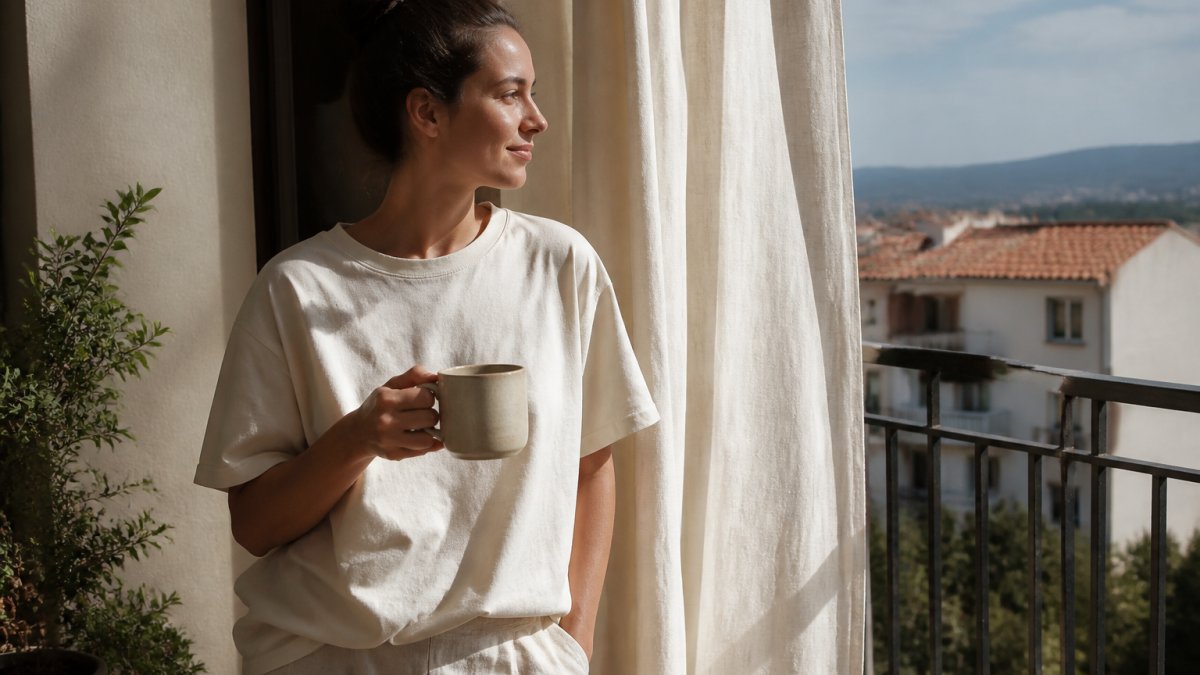
Unisex Staple Eco T-shirt: The Lightweight Layer
The Unisex Staple Eco T-shirt is our first pick for warm mornings, priced at $26.50. It is made from 100% recycled materials, specifically 65% recycled polyester and 35% recycled Airlume combed and ring-spun cotton, with the recycled content certified under GRS.

At 4.2 oz./yd.² (142 g/m²), the fabric is genuinely lightweight, which is what you want when the kitchen is already warm from the kettle. The regular fit and side-seamed construction keep it from twisting after a wash.
Unisex Organic Sweatshirt: Warmth for Cooler Mornings
The Unisex Organic Sweatshirt handles the cold-kitchen mornings at $69.50. It is 80% organic combed ring-spun cotton and 20% recycled polyester, with the cotton certified under GOTS and OCS and the recycled content certified under GRS.

The brushed fleece interior is the detail that matters at 6 a.m., and the 10.3 oz./yd.² (350 g/m²) weight gives it real substance without stiffness.
| Pick | Price | Material | Certification | Best For |
|---|---|---|---|---|
| Unisex Staple Eco T-shirt | $26.50 | 65% recycled polyester, 35% recycled cotton | GRS | Warm mornings, lightweight layering |
| Unisex Organic Sweatshirt | $69.50 | 80% organic cotton, 20% recycled polyester | GOTS, OCS, GRS | Cooler mornings, relaxed layering |
How to Build a Sustainable Wardrobe Around Your Coffee Ritual
Building a sustainable wardrobe around your coffee ritual starts with fewer, better pieces you rotate hard, not a closet overhaul. Buy the base layers first, then add one warm layer, then stop.
Our approach, in order:
- Audit what you already wear. Pull the five items you reach for before coffee. Those are your real wardrobe staples.
- Replace the weakest base layer first. A worn-out tee is the highest-use item in the rotation, so it earns the upgrade.
- Add one certified warm layer. One sweatshirt or cardigan covers most cool mornings.
- Set a replacement rule. When a piece pills, stretches, or fades past wearing, replace it with a certified option rather than adding volume.
- Buy for the routine, not the occasion. Everyday essentials beat statement pieces for a ritual you repeat daily.
This is also how to build a sustainable wardrobe without spending a fortune at once. One considered purchase per season beats a cart full of compromises.
Care, Longevity, and End-of-Life for Eco-Friendly Apparel
Longevity is where sustainability claims get tested. A certified shirt worn for a decade beats an uncertified one replaced every year, and care habits decide which outcome you get.
What works in practice:
- Wash cold and inside out. Cold water slows fiber breakdown and protects dyes on darker pieces.
- Skip the dryer when you can. Air-drying preserves elastic ribbing at cuffs and collars.
- Use a mesh bag for recycled blends. It reduces microfiber shedding during the wash cycle.
The U.S. Environmental Protection Agency's textile waste data is worth a look if you want to understand why keeping a garment in use longer is the single biggest lever you control.
One more practical note: keep a dedicated mug for the ritual. A ceramic mug like our White Glossy Mug at $12.00 is dishwasher and microwave safe, so it survives daily use without special handling.

Frequently Asked Questions
What should I wear for a morning coffee run?
A lightweight, breathable layer works best. The Unisex Staple Eco T-shirt ($26.50) is made from 100% recycled materials and suits warm mornings, while the Unisex Organic Sweatshirt ($69.50) adds warmth for cooler days. Pair either with relaxed jeans or linen pants and sneakers. Choose fabrics that feel comfortable against your skin and hold up to repeated washing, since a coffee run often turns into a longer outing.
What are some sustainable clothing brands to consider?
Look for brands that publish third-party certifications rather than vague claims. Cafe de Mattier's apparel carries GRS certification for recycled content and GOTS and OCS certifications for organic cotton. These standards verify material composition through the supply chain. When comparing sustainable clothing brands, check whether the certification applies to the finished fabric or only a fiber, and whether the brand discloses where the blank product is sourced.
What fabrics are best for eco-friendly everyday clothing?
Organic cotton and recycled polyester blends offer a practical balance of breathability and durability. The Unisex Staple Eco T-shirt uses 65% recycled polyester and 35% recycled Airlume combed and ring-spun cotton at 4.2 oz./yd.², making it lightweight for warm weather. The Unisex Organic Sweatshirt uses 80% organic combed ring-spun cotton and 20% recycled polyester at 10.3 oz./yd.² for cooler mornings. Both fabrics hold their shape through regular washing.
How do I care for sustainable clothes so they last longer?
Wash in cold water on a gentle cycle and air-dry when possible to reduce fiber breakdown. Turn garments inside out before washing to protect the surface. For the Enamel Mug ($25.00), hand-wash only and avoid heating liquids directly in it, since that can damage the coating. Store folded rather than hung to prevent stretching. Proper care extends the life of any eco-friendly apparel and keeps certifications meaningful over time.
How can I build a comfortable, sustainable coffee-run outfit?
Start with a base layer like the Unisex Staple Eco T-shirt, add the Unisex Organic Sweatshirt for warmth, and finish with relaxed bottoms and sneakers. Keep accessories minimal. The goal is a small set of versatile pieces you reach for repeatedly rather than a large wardrobe. A White Glossy Mug ($12.00) or Mug With Color Inside ($16.00) rounds out the ritual at home. Build around pieces that work across seasons.
Your morning coffee already gets the careful treatment: single-origin beans, a slow roast, a few unhurried minutes. Your clothing deserves the same standard. Cafe de Mattier roasts small batches from micro-lots and family-owned estates, with French-inspired techniques that bring out floral notes and a silk-like body in every cup. Subscribe to our emails and pair a better cup with a wardrobe built to last.