

How Long Does Slow Roast Coffee Take? A Complete Guide
Table of Contents
- How Long Does Slow Roast Coffee Take? The Direct Answer
- How Long to Roast Coffee Beans by Equipment and Batch Size
- Coffee Roasting Stages and Their Timing
- Coffee Roasting Temperature and Time: What to Monitor
- How to Tell When Slow Roast Coffee Is Done
- Coffee Bean Resting Time After Roasting
- Common Mistakes and Safety Tips for Slow Roasting
- Frequently Asked Questions
Last Updated: October 5, 2026
How Long Does Slow Roast Coffee Take? The Direct Answer
Slow roast coffee typically takes 12 to 20 minutes from start to finish, compared with 8 to 12 minutes for a standard roast. The extra time comes from lower heat and slower development, which builds sweetness and body instead of char.
This guide from Cafe de Mattier covers the full timeline. We will show you how long to roast coffee beans on different setups, what each roasting stage looks like, and how to tell when the beans are done.
Most guides treat roast time as one fixed number. That is the first thing to unlearn.
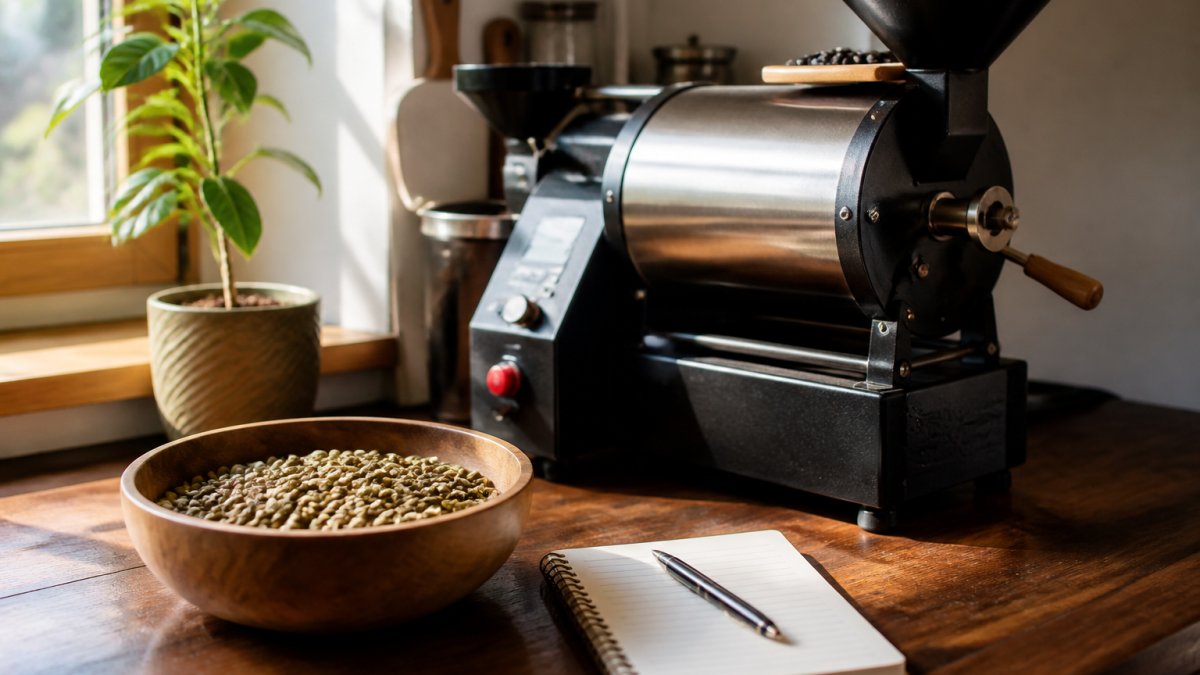
Why Slow Roast Duration Varies
No two roasts run on the same clock. Batch size, equipment, starting moisture, and how you manage heat all push the time up or down.
A small batch roasts faster because heat reaches every bean sooner. A larger batch needs more time to heat through evenly.
How Long to Roast Coffee Beans by Equipment and Batch Size
How long to roast coffee beans depends mostly on your gear and how much you load. A stovetop pan or popcorn popper runs faster and hotter. A drum roaster gives you slower, steadier control. The table below gives working ranges, but treat each row as a starting point you adjust by ear, eye, and nose.
| Setup | Batch Size | Typical Time | Heat Control | Best For Slow Roast? |
|---|---|---|---|---|
| Stovetop pan | 4-8 ounces | 10-15 min | Manual stirring | Yes, with constant attention |
| Popcorn popper | 2-4 ounces | 8-12 min | None, fixed heat | Hard to stretch past 12 min |
| Air roaster | 2-5 ounces | 9-14 min | Fan and heat settings | Moderate, fast airflow |
| Drum roaster (small) | 8-16 ounces | 12-20 min | Adjustable | Yes, best control |
| Drum roaster (large) | 1-2 pounds | 14-22 min | Adjustable | Yes, needs preheat |
Stovetop and Popcorn Popper Timings
Stovetop roasting rewards constant stirring. Keep the beans moving or they scorch on one side. A half-pound batch usually finishes in 10 to 15 minutes. To stretch a stovetop roast toward the slow end, start on medium heat, stir continuously, and lower the flame once the beans turn yellow. If you hear first crack before the 8-minute mark, your pan is too hot.
Popcorn poppers run hot and fast. A small batch can hit first crack in under 8 minutes. That speed leaves little room for a true slow roast. You can slow a popper slightly by using a smaller batch and cycling the unit off and on, but expect a narrower window than a drum roaster gives you.
Air Roaster Timings
Air roasters move heat fast, so timing is tighter. A 3-ounce batch often reaches first crack in 7 to 10 minutes and finishes in 9 to 14 minutes. To slow the roast, lower the fan or heat setting after the drying phase and extend the time between first and second crack. Watch for beans bouncing too aggressively, which can chip them.
Drum Roaster Timings for Small Batches
A drum roaster is the best tool for slow roasting. You can hold heat steady and stretch the roast out. A one-pound batch often takes 12 to 20 minutes. Preheat the drum for 10 to 15 minutes before loading so the drying phase does not drag. For a 1- to 2-pound batch, add roughly 2 to 4 minutes to the total and expect the drying phase to run closer to 6 minutes.
A Practical Timing Workflow
Use the timer as a guide, not a verdict. A simple workflow:
- Preheat the equipment and note the start time.
- Mark the end of drying (beans turn yellow, smell like bread), usually 4 to 6 minutes.
- Mark first crack, usually 7 to 12 minutes depending on setup.
- Decide your target: pull 30 to 60 seconds after first crack for light, 1 to 2 minutes for medium, or into second crack for dark.
- Note total time and adjust heat or batch size on the next roast.
If a roast is running long, check three things: batch size (too large slows heat transfer), heat setting (too low stalls the rise), and airflow (too little traps moisture and smoke). Small corrections early beat big corrections late.
Coffee Roasting Stages and Their Timing
Every roast moves through three main coffee roasting stages. Knowing them helps you time each phase instead of guessing.
- Drying phase: 4-6 minutes. Beans lose moisture and turn from green to yellow.
- Maillard phase: 4-8 minutes. Sugars and amino acids react, building color and flavor.
- Development phase: 2-5 minutes. The roast finishes and flavor deepens.
A slow roast stretches the middle and final stages. That longer development is where complexity and body come from.
Coffee Roasting Temperature and Time: What to Monitor
Coffee roasting temperature and time work together. You cannot judge one without the other. Bean temperature matters more than the dial setting.
Most roasts run between 390°F and 450°F at the finish. A slow roast stays toward the lower end for longer. Watch the rate of rise, which is how fast bean temperature climbs each minute.
A steady, gentle rise beats a fast spike. If the temperature jumps, pull back the heat.
How to Tell When Slow Roast Coffee Is Done
You tell a roast is done by sound, color, and smell, not by the clock alone. The clock guides you. The cues confirm it. The trick is to use all of them together in a repeatable workflow.
Observable Cues: Color, Aroma, and Sound
- First crack: A loud popping, like popcorn. Light roast territory. Usually 7 to 12 minutes in.
- Second crack: A softer, faster crackling. Dark roast territory. Usually 1 to 3 minutes after first crack.
- Color: Tan for light, brown for medium, dark and oily for dark. Pull a bean and crack it open to check the inside color.
- Aroma: Toasty and sweet early, sharper and smokier late. A burnt or ashy smell means you waited too long.
- Smoke: A little wisp is normal near the end. Heavy, rolling smoke means pull the beans now.
Pull the beans between first and second crack for a balanced medium roast. For a dark roast, let them reach the edge of second crack.
A Step-by-Step Timing Workflow
- Start the timer when the beans hit the heat.
- Note the drying phase end (yellow color, bread aroma), aim for 4 to 6 minutes.
- Note first crack, aim for 7 to 12 minutes depending on setup.
- Decide your target window: 30 to 60 seconds past first crack for light, 1 to 2 minutes for medium, into second crack for dark.
- Pull the beans, start cooling immediately, and write down the total time.
Compare that total to your target range. If it is close, repeat the same settings. If it is off, change one variable at a time.
Adjusting a Roast That Is Taking Too Long
A slow roast is the goal, but a stalled roast is a problem. If the beans sit in the drying phase past 7 minutes or first crack past 14 minutes, try these fixes:
- Reduce batch size. A smaller load heats through faster and gives you more control.
- Raise heat slightly. A gentle bump, not a spike, restarts the rise.
- Improve airflow. Better airflow carries off moisture and smoke so heat reaches the beans.
- Preheat longer. A cold drum or pan drags the early phase.
Avoid the urge to crank the heat late. A fast finish after a long stall often scorches the outside while the inside stays underdeveloped.
Coffee Bean Resting Time After Roasting
Coffee bean resting time after roasting matters as much as the roast itself. Fresh beans need to degas before they brew well.
Wait 12 to 24 hours before brewing. For peak flavor, rest beans 3 to 7 days. During this window, they release carbon dioxide and settle into their full taste.
Store beans in an airtight container away from light and heat. Skip the fridge, which adds moisture.
Common Mistakes and Safety Tips for Slow Roasting
The biggest mistake is chasing a fixed time instead of watching the beans. Slow roasting is about control, not the clock.
Other common errors:
- Overloading the roaster, which causes uneven roasting
- Skipping preheating, which stretches the drying phase too far
- Stopping too early and ending up with under-roasted, grassy beans
Safety comes first. Roasting makes smoke, so work near a window or under a vent. Never leave a hot roaster unattended. Keep a fire-safe surface under the equipment and a lid nearby to smother any flare-up.
For a finished cup without the setup, our Italian Roast brings that slow-roasted depth straight to your kitchen.

Frequently Asked Questions
What is the 15-15-15 coffee rule?
The 15-15-15 rule is a guideline for slow roasting: 15 minutes for the drying phase, 15 minutes for the Maillard phase, and 15 minutes for development. This totals about 45 minutes, which is longer than typical fast roasts. It helps home roasters pace the roast evenly and avoid rushing through critical stages. Adjust based on batch size and equipment.
How long should you let coffee rest after roasting?
Most slow-roasted coffee benefits from a resting period of 12 to 48 hours. During this time, beans degas carbon dioxide, which improves flavor stability. For light roasts, wait at least 24 hours; dark roasts may be ready in 12 hours. Peak flavor often develops between 3 and 7 days after roasting.
What is the difference between a slow roast and a fast roast?
A slow roast extends the total roasting duration, often 15 to 25 minutes or more, allowing sugars to caramelize gradually and develop complex flavors. A fast roast finishes in 8 to 12 minutes, producing brighter acidity but less body. Slow roasting requires more attention to heat control and stirring to ensure even development.
Does a longer coffee roast make the coffee less acidic?
Yes, longer roasting generally reduces perceived acidity. As roast time increases, chlorogenic acids break down, resulting in a smoother, less bright cup. Slow roasting can highlight sweetness and body while muting sharp acidity. However, over-roasting can introduce bitter, smoky notes, so balance is key.
Slow roasting rewards patience, and the payoff is a cup with real depth. If you would rather skip the learning curve, Cafe de Mattier does the work for you. Our French-inspired slow-roast tradition and small-batch production deliver complexity, floral notes, and a silk-like body in every bag. Subscribe to our emails and let a mindful coffee experience come to you.