

Air Roast vs Drum Roast: Key Differences Explained
Table of Contents
- Air Roast vs Drum Roast: What Actually Changes in the Cup
- How Heat Transfer Works: Conduction vs Convection Coffee Roasting
- Flavor, Body, and Acidity: The Impact of Roasting Method on Coffee Acidity
- Bean-to-Bean Consistency, Chaff Removal, and Smoke Production
- The Benefits of Slow-Roast Coffee for Micro-Lot Beans
- Maintenance, Emissions, and Environmental Impact
- Which Roasting Method Fits Your Coffee Routine?
- Frequently Asked Questions
Last Updated: October 3, 2026
Air Roast vs Drum Roast: What Actually Changes in the Cup
The difference between air roast and drum roast comes down to one thing: how heat reaches the bean.
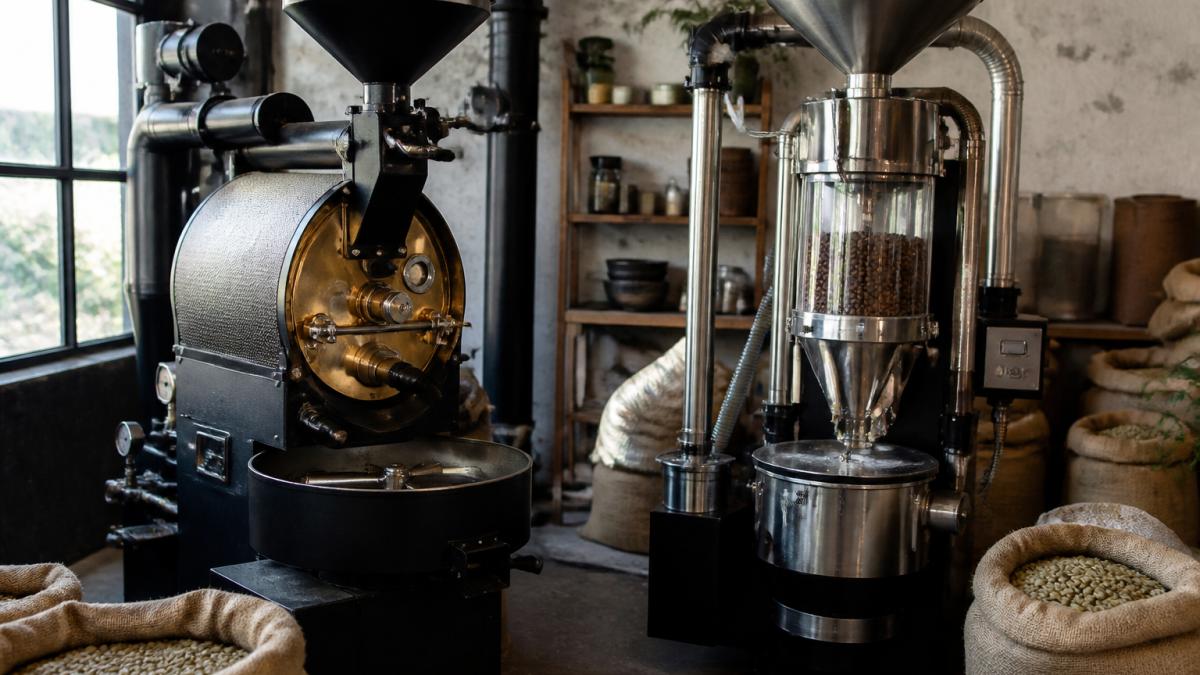
At Cafe de Mattier, we roast in small batches using a slow-roast approach, so we pay close attention to how each method treats the bean. Most guides treat air roast vs drum roast as a simple taste test.
Below, we break down how each method transfers heat, what it does to flavor and acidity, and which one fits your routine.
How Heat Transfer Works: Conduction vs Convection Coffee Roasting
Conduction vs convection coffee roasting is the technical heart of this debate. Conduction is heat transferred through direct contact, like a bean touching a hot metal drum. Convection is heat transferred through moving air, like a hair dryer warming your hand.
Drum roasters rely on both. The metal drum conducts heat into the beans, while hot air moving through the drum adds convection. Air roasters rely almost entirely on convection, which is why they are often called fluid-bed roasters.
Drum Roasting: Conduction and Thermal Mass
Drum roasting leans on thermal mass. The heavy metal cylinder holds heat and releases it steadily into the beans. That stored heat gives the roast a gentler, more gradual curve.
- Heat moves through contact with the drum surface
- Thermal inertia smooths out temperature swings
- Roast development happens slowly and evenly
- Roasters can steer the roast profile with airflow and drum speed
The trade-off is control. A drum holds so much heat that quick adjustments take longer to register.
Air Roasting: Fluid-Bed Convection
Air roasting suspends beans in a stream of hot air, a setup known as a fluid-bed roaster. Every bean gets hit by the same airflow, so heat transfer is fast and uniform.
- Heat moves through moving air, not metal contact
- Beans stay in constant agitation
- Roast time is shorter, often minutes faster
- Temperature control responds almost instantly
That speed is the appeal. It is also the catch, which we will get to.
Flavor, Body, and Acidity: The Impact of Roasting Method on Coffee Acidity
The impact of roasting method on coffee acidity is real, but it is a function of roast curve mechanics rather than the machine itself.
Here is what is actually happening inside the bean:
- Maillard reaction. Amino acids and reducing sugars react starting around 300°F (150°C) and drive much of the browning and the toasted, bready, nutty notes. Drum roasting's thermal mass tends to stretch this phase, which builds more of those deeper Maillard byproducts.
- Caramelization. Sugars break down and recombine from roughly 340°F (170°C) upward. A slower drum curve gives more time here, which is where the heavier caramel and molasses sweetness come from.
- Organic acid degradation. Chlorogenic acids, the main contributors to perceived acidity, break down progressively as roast time and temperature climb (pubmed.ncbi.nlm.nih.gov). A fast fluid-bed roast reaches first crack quickly, so more of those acids survive, and the cup reads brighter and more citric.
- Development time ratio (DTR). Most practitioners target roughly 20-25% of total roast time between first crack and drop. Air roasters often finish a batch in 8-12 minutes, so a 20% DTR is only about two minutes of development. Drum roasters commonly run 12-18 minutes, giving a longer development window at lower drum surface temperatures.
That is the mechanism behind the flavor shorthand:
| Factor | Air Roast (Fluid-Bed) | Drum Roast |
|---|---|---|
| Dominant heat transfer | Convection | Conduction + convection |
| Typical roast time | 8-12 minutes | 12-18 minutes |
| Body | Lighter, tea-like | Fuller, syrupy |
| Acidity | Brighter, more citric | Softer, rounder |
| Caramelization | Lighter | Deeper |
| Sweetness | Cleaner, more fruit-forward | Heavier, more caramel |
| Best for | Sample roasting, clarity, washed Ethiopians | Micro-lots, naturals, espresso profiles |
Acidity is not the same as sourness. A clean cup with bright acidity tastes lively and structured; a sour cup tastes underdeveloped. The difference is usually roast development, not the machine.
Bean density and origin interact with all of this. Dense, high-grown beans, Kenyan AA, most Ethiopian Yirgacheffe lots, Colombian Huila, hold up well to the fast, high-convection profile of a fluid-bed roaster and often show more origin character that way.
Bean-to-Bean Consistency, Chaff Removal, and Smoke Production
Bean-to-bean consistency favors air roasting. Because every bean floats in the same airflow, roast uniformity is high, and there are fewer light or dark outliers in a batch.
Chaff removal works differently too. Chaff is the thin papery skin that sheds during roasting.
- Air roasters blow chaff out automatically through airflow
- Drum roasters collect chaff in a separate tray or cyclone
- De-chaffing by hand adds time and mess in drum setups
Smoke production is the other gap. Drum roasting generates more smoke because beans sit against hot metal longer. Air roasting produces less smoke but moves more air overall.
The Benefits of Slow-Roast Coffee for Micro-Lot Beans
The benefits of slow-roast coffee show up most clearly with micro-lot beans. A slow roast gives the roaster time to develop sugars without scorching delicate floral notes.
Micro-lots are small harvests from a single estate or plot. They carry distinct flavors that a fast roast can flatten. A longer, gentler curve protects those notes.
- More time for caramelization without burning
- Better roast development across the bean's center
- Preserved floral and fruit character
- A silk-like body that builds gradually
This is why we favor a slow-roast tradition at Cafe de Mattier. Our French-inspired approach treats each micro-lot as its own profile, not a copy-paste setting.
Maintenance, Emissions, and Environmental Impact
This is the angle most air-versus-drum comparisons skip entirely: what each machine actually costs you in upkeep, downtime, and environmental load over its service life. The short answer is that the greener machine is the one you maintain, not the one you buy.
Maintenance reality
Drum roasters have more wear points because they have more moving parts and more surfaces that contact the bean:
- Drum and faceplate. Chaff and oils bake onto the drum interior and need scraping every few roasts. Left alone, they carbonize and impart a smoky, ashy note to every batch.
- Bearings and drive motor. The drum spins on bearings that see constant heat cycling. A common pattern is bearing noise or wobble appearing after a few hundred hours of use.
- Seals and gaskets. Door and shaft seals harden with heat and start leaking airflow, which throws off your roast curve before you notice the smoke.
- Chaff tray and cyclone. These fill quickly and need emptying between batches on smaller machines.
Air roasters have fewer moving parts but a different failure profile:
- Heating element. The element cycles hard and is the most common replacement part. Element life varies widely with batch size and airflow.
- Blower motor and bearings. Continuous high-RPM operation wears the blower, and a weak blower means beans stop fluidizing, the roast stalls and scorches.
- Airflow path and filters. Chaff and fine dust clog the path. Restricted airflow is the number-one cause of inconsistent fluid-bed roasts.
- Roast chamber. Needs wiping between batches to prevent oil buildup that smokes on the next roast.
A practical rule: budget a few minutes of cleaning per roast on either machine, plus a deeper teardown every 20-50 roasts depending on batch size and bean oil content.
Emissions and energy
The emissions story is about concentration, not total volume:
- Drum roasters concentrate smoke in a smaller exhaust stream. Afterburners, required in many jurisdictions for commercial roasting, burn off the volatile organic compounds (VOCs) and particulate matter, but they consume additional fuel or electricity to run.
- Air roasters dilute smoke across a much larger air volume, which lowers the concentration at the exhaust but moves more total air. That means bigger ducting and more filter surface area to maintain.
- Energy per batch depends heavily on batch size, insulation, and how much idle time the machine sees. A well-insulated drum holding heat between back-to-back roasts can be more efficient per pound than a fluid-bed unit that heats up and cools down for every small batch. A fluid-bed roaster running continuous small batches with instant on/off control can beat a drum that is constantly reheating its thermal mass.
Neither method is automatically greener. What moves the needle is venting, filter maintenance, afterburner use where required, and running full batches instead of half-empty ones.
Which Roasting Method Fits Your Coffee Routine?
Pick air roasting for clarity, speed, and consistency. Pick drum roasting for body, depth, and control over a slow roast profile.
Ask yourself:
- Do you want bright, clean cups that show off origin? Go air.
- Do you want fuller body and deeper sweetness? Go drum.
- Are you roasting tiny batches to test beans? Air wins on speed.
- Are you chasing complexity in micro-lots? A slow drum roast gives you room.
- Do you have strong ventilation? If not, factor that in before buying.
If you would rather skip the equipment entirely, our small-batch roasts at Cafe de Mattier are built around the slow-roast method, so you get the depth without the setup.
Frequently Asked Questions
What are the key differences between drum and air roasting?
Drum roasters heat beans through a combination of conduction (contact with the hot metal drum) and convection (hot air moving through the drum), while air roasters use a fluid-bed of forced hot air for convection only. This means drum roasting relies on thermal mass and agitation for even development, whereas air roasting uses high-velocity airflow to lift and circulate beans. The result: drum roasts tend to build body and caramelization, while air roasts highlight clarity and acidity.
Does air roasting produce a cleaner cup of coffee than drum roasting?
Air roasting often produces a cleaner cup because the constant airflow pulls chaff away from the beans during the roast, reducing smoke and bitter compounds that can cling to the bean surface. Drum roasting can also yield a clean cup, but chaff removal depends on airflow and de-chaffing equipment. In practice, fluid-bed roasts tend to show brighter acidity and more distinct origin notes, while drum roasts offer deeper body and caramelized sweetness.
Which roasting method is better for highlighting floral notes in micro-lot coffee?
Air roasting (fluid-bed) is often preferred for floral and delicate micro-lot coffees because the fast, even convection heat preserves volatile aromatic compounds and accentuates acidity. Drum roasting can also highlight florals if the roast profile is gentle and the roast development is slow, which is the approach behind slow-roast coffee. The key is matching the method to the bean: bright, floral lots often shine in an air roaster, while heavier, chocolatey lots benefit from drum roasting's caramelization.
How does heat transfer differ between air and drum roasters?
In a drum roaster, heat transfers to beans through conduction from the hot metal drum and convection from hot air moving through the drum. In an air roaster, heat transfers almost entirely through convection as a fluid-bed of hot air lifts and circulates the beans. This difference affects roast time, temperature control, and bean-to-bean consistency: air roasters heat faster and more uniformly, while drum roasters rely on thermal inertia for a slower, more gradual roast development.
Choosing a roasting method is really about matching heat transfer to the flavors you love. At Cafe de Mattier, we slow-roast micro-lot beans from family-owned estates using French-inspired techniques, small-batch production, and a focus on complexity, floral notes, and a silk-like body. Subscribe to our emails to follow each new micro-lot and find the roast that fits your morning ritual.