

How to Brew Coffee Step by Step: A Complete Guide
Table of Contents
- What You'll Need Before You Brew
- Coffee Brewing Ratios: The Foundation of a Balanced Cup
- Best Coffee Grind Size for Brewing: Matching Grind to Method
- Water Temperature for Coffee Brewing: The Invisible Variable
- Step-by-Step: How to Brew Coffee with a Pour-Over
- Step-by-Step: How to Brew Coffee with a French Press
- Coffee Sensory Evaluation at Home: Diagnosing Your Brew by Taste
- Frequently Asked Questions
Last Updated: September 23, 2026
What You'll Need Before You Brew
Great coffee starts with the right tools, not expensive ones. Before you learn how to brew coffee step by step, gather a digital scale, a burr grinder, a gooseneck kettle, a filter, and fresh whole beans. A scale matters more than any single piece of gear because it turns guesswork into repeatable results.
Here's your starting checklist:
- Digital scale accurate to 0.1 g
- Burr grinder (hand or electric)
- Gooseneck kettle with a thermometer
- Pour-over dripper or French press
- Filtered water
- Beans roasted within the last few weeks
Coffee Brewing Ratios: The Foundation of a Balanced Cup
Coffee brewing ratios determine everything downstream. A coffee-to-water ratio is the weight of dry coffee compared to the weight of water, expressed in grams. The Specialty Coffee Association's widely used starting point is roughly 1:15 to 1:18, meaning one part coffee to fifteen or eighteen parts water (EXTERNAL_LINK: Specialty Coffee Association brewing standards | sca.coffee).
| Taste Result | Likely Cause | Adjustment |
|---|---|---|
| Weak, watery | Too much water | Add 1-2 g coffee |
| Harsh, bitter | Too little water | Add 20-30 g water |
| Sour, thin | Under-extracted | Grind finer |
| Dry, chalky | Over-extracted | Grind coarser |
Best Coffee Grind Size for Brewing: Matching Grind to Method
The best coffee grind size for brewing is not a fixed number, it is a function of contact time and surface area. Finer grounds expose more surface to water per gram, so extraction happens faster; coarser grounds expose less, so extraction happens slower. Match grind to your method's contact time and the rest of your variables fall into place. This single adjustment fixes more bad cups than any other change.
| Method | Grind Size | Typical Contact Time | Reference Setting (burr) |
|---|---|---|---|
| French press | Coarse | 4 minutes | ~30-34 clicks on a common hand grinder |
| Drip coffee | Medium | 4-6 minutes | ~22-26 clicks |
| Pour-over | Medium-fine | 2.5-3.5 minutes | ~18-22 clicks |
| AeroPress | Fine | 1-2 minutes | ~12-16 clicks |
| Moka pot | Fine | 3-5 minutes | ~10-14 clicks |
| Espresso | Very fine | 25-30 seconds | ~6-10 clicks |
Why particle distribution matters more than average size
A grinder does not produce one uniform particle size, it produces a distribution. The narrowness of that distribution is what separates a $40 blade grinder from a $150 burr grinder. A blade grinder shatters beans randomly, so a single batch contains powder fine enough for espresso and boulders coarse enough for a French press. Water hits the powder first and rips out bitterness while the boulders stay under-extracted and sour, a signature no ratio can fix.
How to dial in grind by taste, not by chart
Charts get you into the ballpark. Taste gets you to the cup. Use this loop:
- Brew a cup with your current setting and taste it at a temperature you can actually sip, around 140-150°F.
- If it tastes sour, thin, or sharp, the grind is too coarse for the contact time. Move one or two clicks finer and brew again.
- If it tastes bitter, drying, or ashy, the grind is too fine. Move one or two clicks coarser.
- Change only grind between brews. If you also change dose or temperature, you cannot attribute the difference to any one variable.
Water Temperature for Coffee Brewing: The Invisible Variable
Water temperature for coffee brewing should sit between 195°F and 205°F for most methods. Below that range, water under-extracts and the cup tastes sour and weak; above it, you scorch the grounds and pull out bitterness. Boiling water hits 212°F at sea level, so let your kettle rest 30-60 seconds after boiling. A gooseneck kettle with a thermometer removes the guesswork.
Why water chemistry matters more than most brewers realize
Coffee is roughly 98 percent water by weight. The minerals in that water, primarily calcium and magnesium, bind to flavor compounds in the grounds and carry them into the cup. Magnesium pulls out fruity and floral notes; calcium favors heavier, chocolatey compounds. Strip those minerals out and extraction stalls, which is why distilled water produces a hollow, flat cup no matter how good the beans are.
Hard vs. soft water: what each does to your cup
| Water profile | What it does | What to do |
|---|---|---|
| Very hard (high calcium, high bicarbonate) | Mutes acidity, flattens aromatics, scales equipment | Blend with filtered or low-mineral water, or use a softening filter |
| Very soft or distilled | Under-extracts, tastes hollow and papery | Add mineral content via a brewing-water packet or a pinch of Epsom salt and baking soda |
| Balanced (moderate hardness, low bicarbonate) | Clear acidity, full aroma, clean finish | This is the target, most filtered tap water lands here |
A $15 TDS meter gives you a fast reading of your tap water. Above 250 ppm, blend with filtered water; below 50 ppm, add minerals back. A simple carbon filter, the kind in most pitcher and faucet systems, gets most home brewers into the balanced band.
Temperature and water quality interact
Hotter water extracts faster, but it also amplifies whatever the water is doing. Brew with very hard water at 205°F and you pull out harsh, chalky notes; the same beans with balanced water at 200°F taste clean. Changing your water source can feel like changing your grinder, the effect is that large.
Step-by-Step: How to Brew Coffee with a Pour-Over
Pour-over rewards patience and gives you total control. Here's how to brew coffee step by step with a dripper, using a 1:16 ratio.
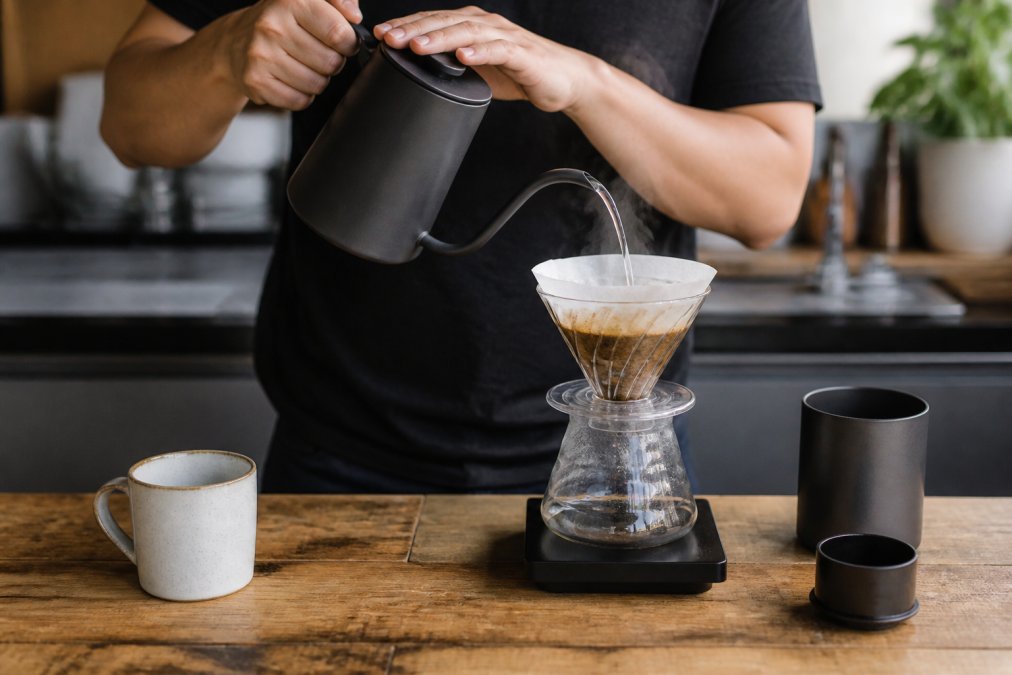
Total Time: 4 minutes Difficulty: Beginner
- Heat water to 200°F. [Time: 2 minutes]
- Rinse the filter with hot water, then discard the rinse. This removes paper taste and preheats the vessel.
- Add 22 g medium-fine coffee to the rinsed filter and level the bed.
- Bloom: pour 50 g water, wait 30-45 seconds. Fresh beans release carbon dioxide here, and skipping this step causes uneven extraction.
- Pour in circles to 360 g total, keeping the water level steady. Finish by 3 minutes.
- Let it drain fully, about 30 seconds. Total brew time should land near 3.5 minutes.
Step-by-Step: How to Brew Coffee with a French Press
The French press trades clarity for body. Its full-immersion method, where grounds steep in water rather than water passing through them, produces a heavier mouthfeel and richer texture.
- Grind 30 g coarse coffee and add it to the press.
- Pour 480 g water at 200°F over the grounds.
- Stir gently and let it steep for 4 minutes.
- Press slowly with steady pressure.
- Decant immediately into a mug or carafe. Leaving coffee on the grounds keeps extracting and turns the cup bitter.
Coffee Sensory Evaluation at Home: Diagnosing Your Brew by Taste
Work through this diagnostic sequence:
- Sour or sharp? Under-extracted. Grind finer, raise temperature, or extend brew time.
- Bitter or drying? Over-extracted. Grind coarser, lower temperature, or shorten brew time.
- Weak but not sour? Too much water. Tighten your ratio.
- Flat or papery? Stale beans or an unrinsed filter.
Sustainability closes the loop here. A metal mesh filter replaces disposable paper, spent grounds compost cleanly, and buying whole beans in recyclable packaging cuts waste at every step (EXTERNAL_LINK: USDA guidance on composting organic waste | usda.gov).
Frequently Asked Questions
How much coffee do I use to make 2 cups of coffee?
For two 8-ounce cups, use 16 ounces of water and about 1 ounce (roughly 2 tablespoons) of ground coffee. This follows the standard 1:16 coffee brewing ratio, which produces a balanced cup without being too weak or too strong. Adjust slightly stronger or weaker based on your taste preference and the specific beans you are using.
What is the ideal water-to-coffee ratio for a balanced cup?
The Specialty Coffee Association recommends a starting ratio of 1:16 to 1:18, meaning one part coffee to 16-18 parts water by weight. For a single 10-ounce cup, that means about 18 grams of coffee to 300 grams of water. A digital scale gives you the most consistent results. If the cup tastes weak, tighten the ratio; if it tastes harsh, loosen it slightly.
How does grind size affect the brewing process?
Grind size controls how quickly water extracts flavor from the coffee grounds. Fine grinds expose more surface area and extract faster, which suits pour-over and espresso. Coarse grinds extract slower, which works best for French press and cold brew. If your coffee tastes bitter, the grind is likely too fine; if it tastes sour or weak, it is probably too coarse. Match your grind to your brewing method for consistent results.
How do I brew one cup of coffee using a pour-over?
Heat water to 195-205°F, place a paper filter in your dripper, and rinse it with hot water. Add 18 grams of medium-fine ground coffee, then pour 50 grams of water to bloom the grounds for 30 seconds. Continue pouring in slow circles until you reach 300 grams total. The entire brew should take about 3 minutes. Serve immediately for the best flavor and aroma.