

7 Differences Between Organic and Ethical Coffee
Last Updated: October 24, 2026
Quick Summary
Organic coffee certifies how beans were grown, banning synthetic pesticides and fertilizers, while ethical coffee certifies how farmers and workers were treated and paid. Organic covers farming inputs and land management, not labor; ethical covers fair price, labor rights and worker safety, not chemicals. A bag can be one, both, or neither.
- Organic certification bans synthetic pesticides and fertilizers but sets no minimum price for farmers.
- Fair Trade certification requires a guaranteed minimum price plus a social premium for community development.
- Direct trade has no universal standard or third-party audit, so trust rests on the roaster's transparency.
- A $20 bag does not reliably send more money to the farmer than a $12 bag.
- Dual certification means a farm passed two separate audits: one for chemical inputs, one for labor and pricing.
Table of Contents
- The Core Difference: Farming Method vs. Business Practice
- Fair Trade Certification Requirements: The Labor Side
- How to Identify Ethically Sourced Coffee on a Bag
- What Is Direct Trade Coffee, and Why It Skips the Label
- Organic Coffee vs. Ethical Coffee: A Side-by-Side Comparison
- Coffee That Is Both Organic and Ethically Sourced
- Costs and Premiums: Where Your Money Actually Goes
- The Limits of Labels: Trade-Offs and What They Miss
- Frequently Asked Questions
The Core Difference: Farming Method vs. Business Practice
Organic is a farming standard; ethical is a business standard. Organic coffee certifies how the beans were grown; ethical coffee certifies how the people who grew them were treated and paid.
We source from micro-lots and family-owned estates, and buyers constantly assume the two terms are interchangeable. They are not.
Here is the short version:
- Organic answers: Were synthetic chemicals used on this land?
- Ethical answers: Were the farmers and workers treated and paid fairly?
- A bag can be one, both, or neither.
Here are the differences, starting with what each certification covers.
What Organic Certification Actually Covers
Organic certification covers farming inputs and land management, not labor. It bans synthetic pesticides, fertilizers, and prohibited herbicides, requires natural fertilizers and buffer zones between organic and conventional fields.
In the United States, the USDA National Organic Program sets these rules and requires third-party certification before a bag can carry the USDA Organic seal.
What organic certification does not do:
- It does not set a minimum price for farmers.
- It does not inspect worker safety or labor conditions.
- It does not guarantee fair pay or community investment.
A farm can be fully organic and still pay harvest workers poorly. The label simply was not built to check that.
What Ethical Coffee Actually Covers
Ethical coffee covers the human side of the supply chain: fair price, labor rights, worker safety, and community development. It is broader and looser than organic, with no single legal definition in the U.S. It usually means one of three things:
- A third-party certification such as Fair Trade, which audits labor and pricing standards.
- A direct trade relationship between a roaster and a farm.
- A roaster's own responsible sourcing claims, which may or may not be verified.
Ethical sourcing weighs farmer compensation, worker safety, and whether cooperatives receive a stable minimum price.
The key point: ethical claims describe business practices, not whether synthetic pesticides were used.
Fair Trade Certification Requirements: The Labor Side
Fair Trade certification sets the labor and pricing rules organic leaves out, verified through regular third-party audits. Core requirements generally include:
- A guaranteed minimum price for coffee beans, which acts as a floor when market prices fall
- A social premium paid on top of the base price, directed to community development
- No forced labor and no child labor
The Fair Trade USA standards publish the full criteria and audit process. The U.S. Department of Labor guidance on child labor in agriculture also sets legal boundaries that certified farms must respect.
What Fair Trade does not require is organic farming. A farm can be Fair Trade certified while still using synthetic fertilizers, the mirror image of an organic farm with no labor standards.
How to Identify Ethically Sourced Coffee on a Bag
To identify ethically sourced coffee, read the seals first, then the origin details, then the roaster's claims. A bag with no seal and no named farm has no verification.
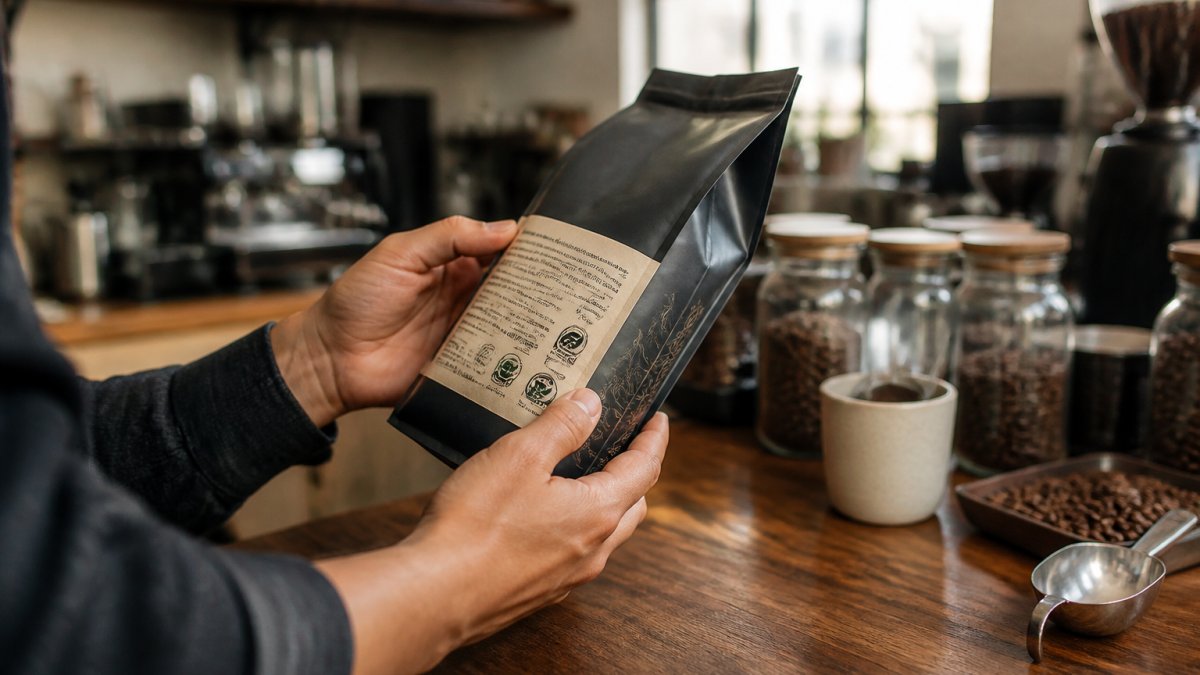
Work through this checklist in order:
- Look for a third-party seal. Fair Trade, Rainforest Alliance, or a recognized equivalent. A seal means an independent auditor checked the claim.
- Check for the USDA Organic mark if chemical-free farming matters to you. That is the only organic claim with legal weight in the U.S.
- Find the farm or cooperative name. Traceability starts with a named producer, not a country alone.
For a deeper walkthrough, see our guide on how to identify ethically sourced coffee. A common mistake is trusting a single seal to answer both the farming and labor questions. You need to check both.
What Is Direct Trade Coffee, and Why It Skips the Label
Direct trade coffee is a sourcing model where a roaster buys straight from a farm or producer group, usually above commodity rates, without a certification body.
The appeal is speed and relationships: a roaster can pay a premium, visit the farm, and set terms for a micro-lot without annual audit paperwork.
The trade-off is verification. Direct trade has no universal standard, no third-party audit, and no public criteria, so trust sits entirely with the roaster's transparency.
Direct trade can be more ethical than a certified program, or less. For the farm-level sourcing involved, a guide to micro lot coffee beans explains what those small lots are and why they matter.
Organic Coffee vs. Ethical Coffee: A Side-by-Side Comparison
Organic coffee and ethical coffee overlap on environmental care but diverge on what each claim verifies, who checks it, and where the audit stops.
| Question | Organic Coffee | Ethical Coffee |
|---|---|---|
| What it certifies | Farming inputs and land management | Labor, pay, trade terms, and in some programs environmental practices |
| Regulated term in the U.S. | Yes, USDA Organic under the National Organic Program | No, except specific seals such as Fair Trade Certified |
| Synthetic pesticides and fertilizers | Prohibited; buffer zones required | Not addressed by labor-focused seals; addressed by Rainforest Alliance and similar programs |
| Minimum farmer price | Not required | Core requirement under Fair Trade Certified |
| Worker safety and labor rights | Not addressed | Required under Fair Trade and Rainforest Alliance |
| Who audits | USDA-accredited certifying agents | Fair Trade USA or program-specific auditors |
| Chain of custody | Required from farm to roaster for the seal to apply | Required for certified programs; varies by standard |
| Audit frequency | Annual inspection plus unannounced spot checks | Annual audit plus periodic surveillance |
| Typical extra cost | Farming transition, certification, and inspection fees | Premium, social premium, and audit fees |
| Best for buyers who care about | Soil, chemicals, biodiversity | Farmers, workers, communities |
What Each Certification Actually Verifies
The table hides the key difference: what the auditor inspects and what it never sees.
Organic verification traces the crop from field to roaster.
Fair Trade verification traces the transaction: the cooperative's structure, contract terms, minimum price paid, and social premium disbursement, plus labor conditions including forced labor, child labor, and freedom of association.
That is the practical answer to the keyword: organic verifies the land, ethical certification verifies the deal and the people.
Where the Two Standards Overlap
Both require third-party inspection, record-keeping, and producer costs, and both address environmental practices to some degree: organic through input rules, Fair Trade by prohibiting the most hazardous pesticides and requiring integrated pest management. Rainforest Alliance combines environmental and labor criteria in one standard, which is why some buyers treat it as a bridge. The overlap is real but partial: a farm can hold Fair Trade certification and still use synthetic fertilizers that organic rules prohibit, or hold organic certification and still pay harvest workers below a living wage.
A Practical Buying Framework
Use the table as a decision tool:
- If your priority is reducing synthetic chemical exposure and supporting ecological farming, look for the USDA Organic seal first.
- If your priority is fair compensation and labor conditions, look for Fair Trade Certified or a comparable labor standard.
- If your priority is the fullest picture, look for both seals on the same bag, or a named farm with a published sourcing report.
Coffee That Is Both Organic and Ethically Sourced
Coffee can be both organic and ethically sourced, and the best bags usually are. Dual certification means a farm passed two separate audits: one for chemical inputs, one for labor and pricing.
Dual-certified coffee is not rare, but it is not the default either.
A bag with both marks pays for two verification systems, and the premiums stack. For buyers who want the fullest picture, dual-certified micro-lots from family-owned estates are the strongest signal available. Our own sourcing leans on exactly these small, traceable lots.
Costs and Premiums: Where Your Money Actually Goes
Certified coffee costs more, and the premium does not all go to the farmer. The money trail is messier than a label suggests.
The Four Places a Premium Lands
A price premium on certified coffee flows through four buckets, and only one reliably reaches the producer:
- Certification and audit fees. The farm or cooperative pays the certifier, not the roaster. Under Fair Trade, the cooperative typically covers initial certification and annual audit costs from its own funds or the social premium; under organic, the producer pays the USDA-accredited certifying agent. These fixed costs hit small farms hardest.
- Higher production costs. Organic farming often yields less per acre during and after transition, and labor costs rise because weeding and pest management are mechanical or manual rather than chemical. Those costs are passed forward.
- The social premium. Under Fair Trade Certified, the buyer pays a fixed premium above the minimum price, and the cooperative decides democratically how to spend it, usually on community projects, equipment, or quality improvements. This is the most traceable dollar in the chain because the standard requires a paper trail.
Why Retail Price Is a Poor Proxy for Farmer Benefit
A $20 bag does not reliably send more money to the farmer than a $12 bag. The farmer's share depends on supply chain length, contract terms, and the certification program, not shelf price alone.
A longer chain with exporters, importers, and distributors absorbs more of the premium.
The farm-gate price for certified coffee is a small fraction of retail, and the social premium a smaller fraction still.
The Small-Farm Cost Burden
Certification is not free, and fixed costs fall hardest on growers with the least capital.
That is why some careful growers carry one seal and follow the other program's practices without the paperwork, and why group certification, where a cooperative is certified as a unit, is common.
The honest answer to "why does this cost more?" is that you pay for verification, higher production costs, and in good supply chains a fairer deal at the farm.
For a full breakdown of what drives specialty coffee prices, read why specialty coffee costs more. And if you are weighing whether the premium is worth it at all, our honest review of whether gourmet coffee is worth it covers that question directly.
The Limits of Labels: Trade-Offs and What They Miss
Labels are useful but incomplete. Every certification covers a defined slice of the supply chain and leaves the rest unexamined.
What the labels miss:
- Organic says nothing about pay. A certified organic farm can still underpay workers.
- Fair Trade says nothing about chemicals. A Fair Trade farm can still use synthetic fertilizers.
- Audits are periodic. A certification reflects conditions at inspection time, not every day of the year.
Treating a single seal as proof of a fully ethical supply chain is a common buying mistake.
The better approach is to combine signals: a named farm, a recognized certification, transparent sourcing language, and a fresh roast date.
The real challenge is finding coffee where the farming and the business practices both hold up, and where you can see the evidence.
Frequently Asked Questions
Does organic coffee mean it is also ethically sourced?
No. Organic certification addresses how coffee is grown: no synthetic pesticides, herbicides, or fertilizers, and specific soil and biodiversity standards. It says nothing about farmer pay, labor conditions, or worker safety. A bag can be certified organic while the farm workers who picked it were paid below a living wage. To confirm ethical sourcing, look for a separate labor standard such as Fair Trade certification or a documented direct trade relationship.
What is the difference between Fair Trade and organic coffee?
Fair Trade certification sets requirements for labor and trade: minimum prices, a price premium paid to producer cooperatives, no child or forced labor, and worker safety rules. Organic certification sets requirements for farming inputs and environmental practices. They are verified by different bodies and cover different parts of the supply chain. Many coffees carry both seals, but holding one does not imply the other.
How can I tell if my coffee is ethically sourced?
Start with certification labels you can verify, such as Fair Trade, then check the roaster's own disclosures. Look for the named farm or cooperative, the region, and whether the roaster publishes what it pays above the commodity price. Direct trade coffee often skips a third-party seal but includes this information on the bag or website. If a bag says only 'ethically sourced' with no farm name, certification, or audit trail, treat the claim as marketing.
Are there certifications for ethical coffee in the US?
Yes. Fair Trade Certified and Fairtrade International both operate in the US market and require third-party audits of labor conditions and trade terms. Organic certification is governed by the USDA National Organic Program, but it covers farming practices, not labor. Rainforest Alliance also certifies against combined environmental and social criteria. Each label has different standards, so check which specific claims a seal actually verifies before relying on it.
